
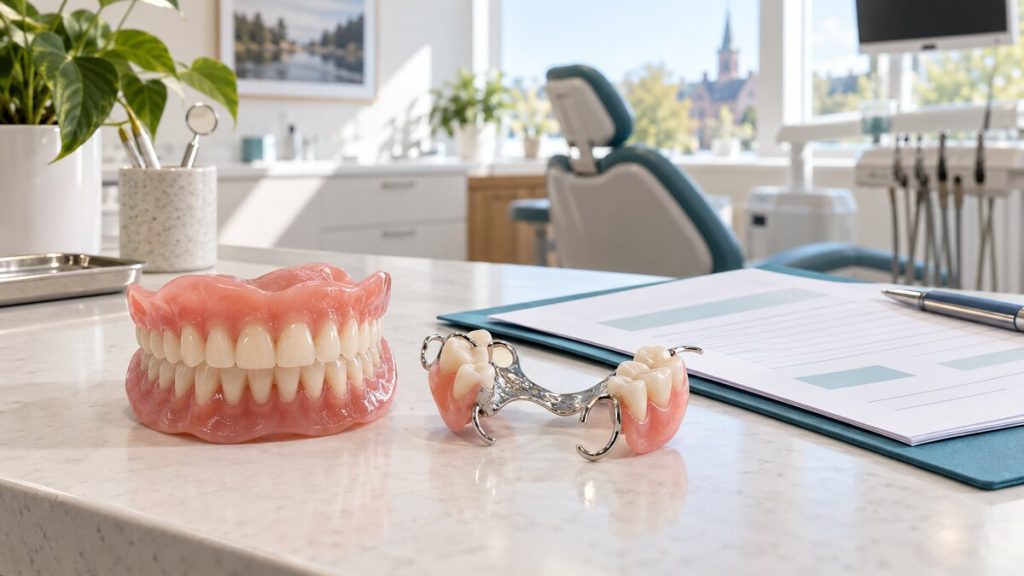
If you are looking for information about CDCP coverage for dentures in Orangeville, certain removable full and partial denture services may be eligible under the Canadian Dental Care Plan. Coverage depends on the type of denture, clinical eligibility, frequency limitations, preauthorization requirements and the current CDCP rules.
This guide explains how CDCP dentures Orangeville rules work in practice, so you know what to confirm with the clinic before treatment begins.
CDCP coverage does not necessarily mean that every denture service is fully paid for or that every patient will qualify for the same treatment. Your individual oral health, the type of denture being considered and the CDCP-established fees all affect what may be covered and what you may need to pay.
This guide focuses specifically on CDCP coverage for removable full and partial dentures in Orangeville and explains what patients should know before beginning treatment.
Who is eligible for the CDCP? The Canadian Dental Care Plan is for Canadian residents who do not have access to dental insurance — through an employer, a school, a pension plan, or a plan they bought themselves — and whose adjusted family net income is under $90,000. The share of costs the CDCP pays depends on that income, so two patients can have different coverage for the same denture. Eligibility is confirmed before treatment begins, and your clinic can help you check yours.
| Denture Service | Current CDCP Rule |
| Standard Complete Denture | Generally eligible once per arch in any 96 months (8 years). Standard complete dentures do not normally require preauthorization. |
| Partial Acrylic Denture | Generally eligible once per arch in any 60 months (5 years). Initial placement requires preauthorization. |
| Partial Cast Denture | Generally eligible once per arch in any 96 months (8 years). Initial placement requires preauthorization. |
| Post-Insertion Care | The CDCP fee for complete and partial dentures includes a 3-month period of post-insertion care. |
| Implant-Supported Dentures | Not covered. Implant-supported complete and partial dentures and implant-related procedures are exclusions under the CDCP. |
Does the CDCP Cover Dentures?
Yes. The Canadian Dental Care Plan includes coverage for certain eligible removable denture services.
The current CDCP Dental Benefits Guide includes removable complete dentures and removable partial dentures within its prosthodontic benefits. Each service is subject to specific eligibility criteria, frequency limitations and preauthorization rules.
Coverage is determined on an individual basis. Having CDCP coverage does not automatically mean that every denture design or every proposed procedure will be eligible.
If you need a broader explanation of the program itself, see our guide to the Canadian Dental Care Plan.
CDCP Coverage for Full Dentures
Full dentures, also called complete dentures, replace all of the natural teeth in an upper or lower arch.
Under the current CDCP rules, a standard complete denture is generally subject to a frequency limitation of one denture per arch in any 96-month period, which is eight years.
Standard complete dentures do not normally require preauthorization. However, certain other complete-denture designs, including complete overdentures and standard complete dentures with a long-term soft liner, require preauthorization under the current program.
Frequency eligibility does not by itself guarantee coverage. The treatment must still meet applicable CDCP requirements and be clinically appropriate for the patient.
CDCP Coverage for Partial Dentures
A removable partial denture replaces some missing teeth when natural teeth remain in the arch.
The CDCP distinguishes between several types of removable partial dentures. Two commonly relevant categories are acrylic partial dentures and cast partial dentures.
Under the current CDCP rules:
- Removable partial acrylic dentures are generally subject to a frequency limitation of one per arch in any 60 months, or 5 years.
- Removable partial cast dentures are generally subject to a frequency limitation of one per arch in any 96 months, or 8 years.
Initial placement of a removable partial denture requires CDCP preauthorization.
This is an important difference from a standard complete denture. The dental office must submit the required clinical information and receive a coverage decision before an initial partial denture that requires preauthorization proceeds under the CDCP.
Do Partial Dentures Require CDCP Preauthorization?
Yes. Initial placement of removable partial dentures requires preauthorization under the current CDCP Dental Benefits Guide.
Preauthorization means the proposed treatment is reviewed against the CDCP’s clinical criteria before coverage is approved. It should not be treated as an automatic approval simply because a patient is enrolled in the CDCP.
The CDCP also has clinical eligibility criteria for partial dentures. For example, existing tooth decay, periodontal disease and periapical disease generally need to be appropriately addressed as part of the patient’s basic treatment needs before partial-denture coverage is considered.
The location and number of missing teeth are also considered. This means that having one or more missing teeth does not automatically make every partial denture eligible for CDCP coverage.
What May Be Needed for Partial Denture Preauthorization?
The documentation needed depends on the individual case and the CDCP requirements in effect when the request is submitted.
According to the current CDCP Dental Benefits Guide, a partial-denture preauthorization request may require information such as:
- A completed dental claim or treatment form
- A treatment plan showing relevant completed and pending treatment
- Recent dental radiographs or permitted alternative clinical records
- Notation of the missing teeth
- Planned extractions when applicable
The exact documentation is determined by the case and current CDCP requirements. Additional information may be requested when needed to assess eligibility.
How Often Can the CDCP Cover a New Denture?
The answer depends on the type of removable denture.
| Denture Type | General Frequency Limitation |
| Standard Complete Denture | 1 per arch in any 96 months (8 years) |
| Partial Acrylic Denture | 1 per arch in any 60 months (5 years) |
| Partial Cast Denture | 1 per arch in any 96 months (8 years) |
These are general frequency limitations, not guarantees that a replacement will automatically be covered.
The CDCP has additional rules for replacement dentures, dentures previously paid for by the CDCP, relines, rebases and requests that fall outside normal frequency limits. When a replacement is being considered, the dental office should confirm the patient’s current eligibility before treatment begins.
What Is Included After a New Denture Is Inserted?
The current CDCP Dental Benefits Guide states that the CDCP fee for complete and partial dentures includes a 3-month period of post-insertion care.
This is relevant because a new removable denture may need professional review after insertion as the patient adapts to it and the dentist evaluates fit, pressure areas and function.
Not every future adjustment, repair, reline or denture service is automatically included indefinitely. These services have their own CDCP rules and frequency limitations.
Does the CDCP Cover Denture Repairs and Relines?
The CDCP includes certain denture maintenance services, but frequency limits apply.
Under the current guide:
- Denture repairs and additions are generally limited to one per arch in any 12 months.
- Relines and rebases are generally limited to one per arch in any 24 months.
- Tissue conditioning is generally limited to one per arch in any 24 months.
The CDCP also states that a new denture will generally not be covered within 24 months of a reline or rebase. Because maintenance decisions can affect later eligibility, ask how a proposed service may affect future denture coverage before proceeding.
Does the CDCP Cover 100% of Denture Costs?
Not necessarily.
The percentage the CDCP pays toward eligible services is based partly on your adjusted family net income and is calculated using the CDCP-established fees.
| Adjusted Family Net Income | CDCP Share of Eligible Costs at CDCP-Established Fees | Patient Co-Payment Share |
| Lower than $70,000 | 100% | 0% |
| $70,000 to $79,999 | 60% | 40% |
| $80,000 to $89,999 | 40% | 60% |
Even when the CDCP covers 100% of an eligible service at the CDCP-established fee, that does not necessarily mean there will be no patient cost.
Additional charges may apply if the dental provider’s fee is higher than the amount the CDCP reimburses or if the patient agrees to treatment or services that are not covered by the CDCP.
For that reason, ask for an estimate before treatment and confirm what portion is expected to be paid by the CDCP and what amount, if any, you may need to pay directly.
Considering Full or Partial Dentures in Orangeville?
Contact U Smile Dentistry to request a denture assessment. The dental team can review your oral health, discuss suitable removable denture options and provide a treatment estimate based on your individual needs.
Does the CDCP Cover Implant-Supported Dentures?
No. The current CDCP Dental Benefits Guide states that complete and partial dentures supported by dental implants, as well as implant-related procedures, are exclusions and are not covered under the CDCP.
This is an important distinction when comparing removable dentures.
A conventional removable complete or partial denture should not be assumed to have the same coverage as an implant-retained or implant-supported restoration simply because both may be described as dentures.
If you are comparing different denture designs, see our guide to the different types of dentures.
Full Dentures vs Partial Dentures: Which One Applies to You?
A full or complete denture replaces all natural teeth in an upper or lower arch. A partial denture replaces some missing teeth while useful natural teeth remain.
The appropriate option cannot be determined from CDCP coverage alone. Your dentist needs to assess factors such as:
- How many teeth are missing
- Which teeth remain
- The condition of the remaining teeth
- Gum and periodontal health
- Your bite and available space
- Whether additional dental treatment is needed first
- Your ability to maintain the proposed denture
CDCP eligibility should support an appropriate treatment plan rather than determine the treatment by itself.
What If You Already Have an Older Denture?
Whether another denture may be covered depends on the type of existing denture, when it was provided, whether it was paid for by the CDCP and the applicable frequency rules.
The rules for replacement dentures are different from the rules for an initial denture. In some circumstances, preauthorization may also be used to consider a replacement outside the usual frequency limits when the applicable CDCP requirements are met.
Do not assume that the age of your denture alone determines eligibility. The dental office should review the relevant CDCP coverage rules before a replacement treatment plan proceeds.
How Much Will a Full or Partial Denture Cost With the CDCP?
There is no single out-of-pocket amount that applies to every CDCP patient.
Your expected cost can depend on the type of denture, the procedures included in the treatment plan, the CDCP-established fee, your applicable co-payment and whether the provider’s fee is higher than the amount reimbursed by the CDCP.
For a more detailed explanation of denture pricing and laboratory costs, read our guide to how much dentures cost in Ontario.
A written estimate is the most useful way to understand the expected CDCP contribution and any potential patient portion before treatment begins.
Using CDCP Dentures in Orangeville: Next Steps
U Smile Dentistry provides full and partial denture care in Orangeville.
The first step is a dental assessment to determine the condition of your teeth and gums and which removable tooth-replacement options may be clinically appropriate.
If you have CDCP coverage, ask the dental team which parts of the proposed treatment are eligible, whether preauthorization is required and what costs may remain your responsibility before treatment begins.
Contact U Smile Dentistry at (519) 307-6300 or request an appointment online.
FAQs About CDCP Coverage for Dentures
Does the CDCP cover full dentures?
The CDCP covers certain eligible removable complete denture services. Under the current rules, standard complete dentures are generally subject to a frequency limitation of one per arch in any 96 months. Standard complete dentures do not normally require preauthorization, although some other complete-denture designs do.
Does the CDCP cover partial dentures?
The CDCP covers eligible removable partial dentures subject to clinical criteria and frequency limits. Initial placement of a removable partial denture requires preauthorization. Acrylic partial dentures are generally limited to one per arch in any 60 months, while cast partial dentures are generally limited to one per arch in any 96 months.
Do partial dentures require CDCP preauthorization?
Yes. Initial placements of removable partial dentures require preauthorization under the current CDCP Dental Benefits Guide. The proposed treatment must meet the program’s clinical and documentation requirements before coverage is approved.
Does the CDCP pay 100% of denture costs?
Not necessarily. The CDCP pays a percentage of eligible services at CDCP-established fees based partly on adjusted family net income. Patients may also have additional charges if the provider’s fee exceeds the CDCP reimbursement amount or if treatment includes services that are not covered.
Does the CDCP cover implant-supported dentures?
No. Complete and partial dentures supported by implants, along with implant-related procedures, are exclusions under the current CDCP Dental Benefits Guide.
How often can the CDCP cover a new denture?
Frequency depends on the denture type. Standard complete dentures are generally limited to one per arch in 96 months, partial acrylic dentures to one per arch in 60 months, and partial cast dentures to one per arch in 96 months. Additional replacement rules may apply.
Is follow-up care included after getting a denture through the CDCP?
The current CDCP Dental Benefits Guide states that the CDCP fee for complete and partial dentures includes a 3-month period of post-insertion care. Other later adjustments, repairs, relines or rebases are subject to their own program rules and frequency limitations.


