If you are researching denture costs in Ontario, there is no single fixed price that applies to every patient. The total fee depends on the type of denture being made, the number of teeth being replaced, laboratory work, materials, treatment complexity and whether other dental procedures are required before or after the denture is made.
Dentists in Ontario set their own fees. The Ontario Dental Association publishes a Suggested Fee Guide that may be used as a reference, but dental offices are not required to charge the amounts listed in the guide.
The most useful way to compare denture estimates is to understand exactly what is included. Ask which type of denture is being proposed, whether laboratory charges are included, what follow-up care is covered and whether your private dental plan or the Canadian Dental Care Plan may contribute to the cost.
| Denture Type | Main Cost Considerations |
| Partial Denture | Material, number and position of missing teeth, design, remaining teeth and laboratory work |
| Complete Denture | One or both arches, materials, laboratory procedures, fit and follow-up care |
| Immediate Denture | Advance fabrication, planned extractions, healing changes, adjustments and possible relining |
| Conventional Denture | Final impressions after healing, fabrication, fitting and post-insertion care |
| Overdenture | Supporting teeth or implants, attachments, maintenance and the type of prosthesis being planned |
Why Do Denture Prices Vary in Ontario?
Two people who both need dentures may receive very different treatment estimates because their dental needs are not necessarily the same.
One person may need a small removable partial denture to replace several teeth. Another may require a complete upper denture, several extractions and an immediate denture to use while the gums and supporting tissues heal.
The total cost can therefore depend on the denture design, materials, number of appointments, laboratory work and additional treatment required before or after the denture is made.
The Ontario Dental Association explains that factors such as treatment complexity, appointment time, materials, specialized equipment and practice costs can influence dental fees.
How Does the Type of Denture Affect the Cost?
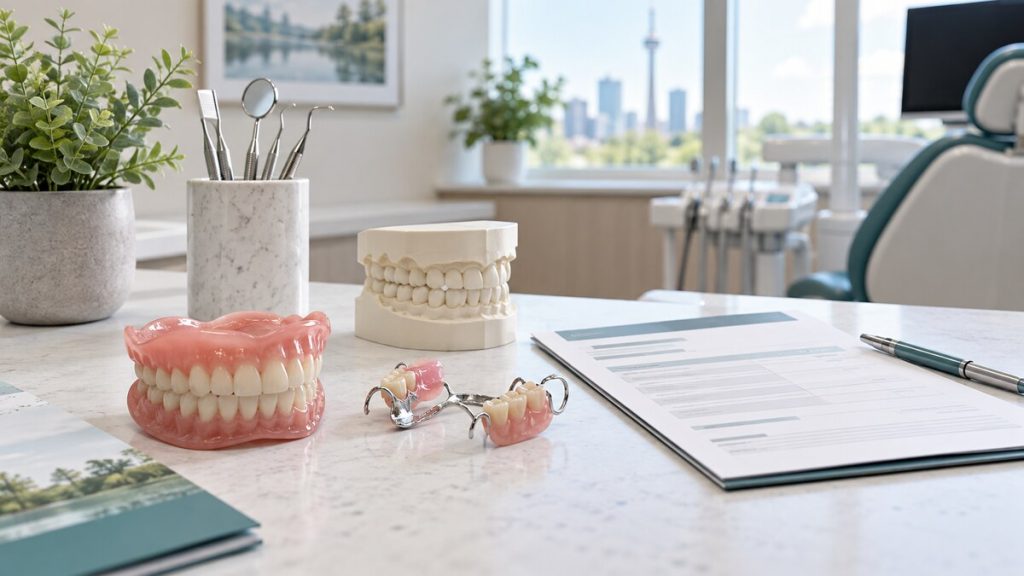
Dentures are commonly divided into partial and complete dentures.
A partial denture replaces some missing teeth while natural teeth remain. A complete denture, sometimes called a full denture, replaces all of the natural teeth in an upper or lower arch.
The Canadian Dental Association also distinguishes between immediate and conventional complete dentures. Immediate dentures are made before planned tooth extractions, while conventional dentures are generally made after the gums and jaw tissues have had time to heal.
Different denture designs involve different materials, laboratory procedures and treatment stages, which can affect the total fee.
Partial Denture Costs
A partial denture may be considered when some natural teeth remain.
The design depends on which teeth are missing, the position and condition of the remaining teeth and the type of material being used. Different partial dentures may also use different methods of support and retention.
Because these factors vary from one patient to another, a useful treatment estimate normally requires a dental examination rather than relying on a generic online price.
If the remaining teeth require fillings, periodontal treatment or other dental care before the partial denture is made, those procedures may also affect the overall treatment cost.
Full Denture Costs
Complete dentures replace all natural teeth in an upper or lower arch.
The fee may depend on whether one arch or both arches are being treated, the materials selected, laboratory procedures and the amount of follow-up care anticipated.
Patients who still have teeth that need to be removed may also need to consider the cost of tooth extraction separately from the denture itself.
For a broader comparison of available designs, see our guide to different types of dentures.
Immediate Denture Costs
Immediate dentures involve a different treatment sequence because the denture must be planned and fabricated before the remaining teeth are extracted.
After the teeth are removed, the shape of the gums and supporting bone changes during healing. This means an immediate denture may require professional adjustments, tissue conditioning or relining as the tissues change.
The Canadian Dental Association notes that healing after extractions can take several months and that immediate dentures may require relining to maintain an appropriate fit.
When reviewing an estimate for immediate dentures, ask whether follow-up adjustments, relining or other post-extraction care are included in the original fee or billed separately.
You can also read our guide to immediate dentures vs permanent dentures for a detailed comparison of the treatment sequence and healing process.
Are Laboratory Fees Included in the Denture Price?
Not necessarily.
Dentures require dental laboratory work. The Ontario Dental Association explains that commercial laboratory charges may be additional to the dentist’s professional fee.
The amount charged reflects the work performed by the commercial dental laboratory for the specific appliance being made.
When you receive a denture estimate, ask whether laboratory charges are:
- Included in the quoted amount
- Listed separately from the dentist’s professional fee
- Expected to vary according to the final denture design or materials
Understanding this before treatment makes it easier to compare estimates accurately.
What Other Costs Can Be Part of Denture Treatment?
The denture itself may not be the only service involved in treatment.
Depending on your oral health and treatment plan, additional services may include:
- Dental examinations
- Dental X-rays when clinically required
- Tooth extractions
- Treatment for cavities or gum disease
- Denture adjustments
- Denture repairs
- Relining or rebasing
A treatment estimate should clearly distinguish between the services involved in making the denture and separate dental procedures being recommended for another reason.
Why a Written Denture Estimate Matters
A written treatment estimate helps you understand what you are actually comparing.
For example, one denture estimate may include several post-insertion appointments while another may list some follow-up services separately.
A useful estimate should identify the type of denture being proposed, any dental treatment required before insertion, expected laboratory charges and anticipated follow-up care.
It is also reasonable to ask whether future adjustments, repairs or relines are included or billed separately.
The goal is not simply to find the lowest advertised number. It is to understand what treatment the number actually represents.
Considering Dentures in Orangeville?
Contact U Smile Dentistry to request a denture assessment. The dental team can review your oral health, discuss the denture options that may be appropriate and provide an estimate based on your individual treatment plan.
Does Dental Insurance Cover Dentures?
Dental insurance coverage depends on the specific plan.
Some plans may cover a percentage of eligible denture treatment. Others may have annual limits, waiting periods, frequency restrictions or rules about when an existing denture can be replaced.
The amount paid by an insurance provider may also be based on a fee schedule that differs from the dentist’s current fee.
Before treatment, ask your insurance provider what services are eligible, what percentage may be reimbursed and whether a predetermination or written estimate should be submitted.
Does the Canadian Dental Care Plan Cover Dentures?
The Canadian Dental Care Plan (CDCP) covers certain removable denture services for eligible members, but coverage depends on the denture type, program rules, frequency limitations and preauthorization requirements where applicable.
Under the current CDCP Dental Benefits Guide, different frequency rules apply to complete dentures, immediate dentures and different types of partial dentures.
Standard complete dentures are generally subject to an eight-year frequency limitation per arch. Complete immediate dentures follow separate rules and are generally limited to one per arch during a client’s lifetime under the current program.
Partial acrylic dentures are generally subject to a five-year frequency limitation per arch, while cast partial dentures are generally subject to an eight-year limitation. Initial partial denture placement may also require preauthorization.
Coverage should always be confirmed before treatment because eligibility, frequency rules and preauthorization requirements can affect what the CDCP will pay.
Does the CDCP Cover Implant-Supported Dentures?
No. The current CDCP Dental Benefits Guide states that complete and partial dentures supported by dental implants, along with implant-related procedures, are excluded from coverage.
This distinction is important because the word “overdenture” may refer to different designs. Some overdentures are supported by remaining natural teeth, while others are retained by dental implants.
Do not assume that a treatment is covered simply because the word “denture” appears in its name. Ask the dental office to identify the procedures being proposed and which parts may be eligible under your plan.
Does CDCP Coverage Mean the Denture Is Free?
Not necessarily.
CDCP coverage depends on the service being eligible, the program’s established fees and the patient’s applicable co-payment.
Additional charges may still apply in some situations, including when the dental office’s fee differs from the CDCP-established amount or when part of the proposed treatment is not covered.
Ask for an estimate before treatment so you understand the expected CDCP contribution and any amount that may remain your responsibility.
How Often Can Dentures Be Replaced Under the CDCP?
Frequency limits depend on the type of denture.
Under current CDCP guidance, standard complete dentures generally have an eight-year frequency limitation per arch. Partial acrylic dentures generally have a five-year limitation, while cast partial dentures generally have an eight-year limitation.
Immediate dentures follow separate rules. A complete immediate denture is generally limited to one per arch during a client’s lifetime. Current CDCP rules also affect when another complete denture may become eligible after an immediate denture has been claimed.
Program rules can change, so current eligibility should be checked when treatment is being planned rather than relying on an older article or previous coverage decision.
Are Repairs, Relines and Adjustments Separate Costs?
They can be.
Dentures are used in a mouth that continues to change over time. Fit can therefore change, particularly after tooth extractions or during the healing period.
The Canadian Dental Association notes that dentures may require periodic adjustment or relining as the mouth changes.
The CDCP also applies separate rules to services such as repairs, relines, rebases and tissue conditioning. For privately paid treatment, ask what follow-up period is included in the original denture fee and which future services would be billed separately.
How Should You Compare Denture Estimates?
Do not compare only the final dollar amount.
Start by confirming that both estimates refer to the same type of denture, similar materials and the same number of arches.
Then compare whether each estimate includes:
- Dental examinations
- Tooth extractions
- Laboratory charges
- Post-insertion appointments
- Adjustments
- Relines or rebases
- Repair provisions
The more clearly the treatment plan is defined, the more meaningful the comparison becomes.
Are Cheaper Dentures Always a Better Value?
Not necessarily.
Price is one consideration, but fit, treatment planning, appropriate materials, follow-up care and your ability to maintain the denture also matter.
A denture that requires additional treatment or frequent adjustment may ultimately involve costs that were not obvious from the original advertised price.
Rather than choosing only by price, ask what the proposed denture is designed to do, how it will be supported, what maintenance is expected and which follow-up services are included.
How Long Do Dentures Last?
There is no universal lifespan that applies to every denture.
The mouth changes over time, and a denture can also wear, break or become less stable.
The Canadian Dental Association recommends regular dental examinations for people who wear dentures because fit can change and the mouth still needs to be examined for disease or other changes.
Replacement timing should be based on the condition of the denture and the mouth rather than waiting for a specific number of years simply because an insurance plan permits replacement.
Denture Costs in Orangeville
U Smile Dentistry provides full and partial denture care in Orangeville.
The cost of treatment depends on the type of denture being considered, the condition of your mouth, required laboratory work and any additional dental procedures that may form part of the treatment plan.
Rather than relying on a generic online price, a dental assessment can provide a more useful estimate based on your individual needs.
If you are using the Canadian Dental Care Plan, the dental team can also review the treatment being proposed and explain whether preauthorization or other CDCP requirements may apply.
Contact U Smile Dentistry at (519) 307-6300 or request an appointment online.
FAQs About Denture Costs in Ontario
How much do dentures cost in Ontario?
There is no mandatory Ontario-wide denture price. Dentists set their own fees, and the cost varies according to the type of denture, materials, laboratory work, treatment complexity and any additional procedures required.
Are laboratory fees included in the denture price?
They may be included or listed separately. Commercial dental laboratory charges can be additional to the dentist’s professional fee, so ask whether laboratory work is included in the written treatment estimate.
Are full dentures more expensive than partial dentures?
Not necessarily in every case. Cost depends on the denture design, materials, number of arches, laboratory work and other treatment requirements. A clinical treatment plan is needed for a meaningful comparison.
How much do immediate dentures cost?
Immediate denture costs depend on the number of teeth being replaced, planned extractions, laboratory fabrication and follow-up needs during healing. Professional adjustments or relining may also be needed as the gums and supporting tissues change.
Does the CDCP pay for dentures?
The Canadian Dental Care Plan covers certain eligible removable complete and partial denture services, subject to program rules, frequency limitations and preauthorization requirements where applicable. Coverage and expected patient costs should be confirmed before treatment.
Does the CDCP cover implant-supported dentures?
No. Implant-supported complete and partial dentures and implant-related procedures are excluded under the current CDCP Dental Benefits Guide. Some non-implant removable denture services may be eligible under separate program rules.
Can I get a denture estimate before treatment?
Yes. A written treatment estimate can explain the proposed procedures, professional fees, laboratory charges and other expected costs before treatment begins.