
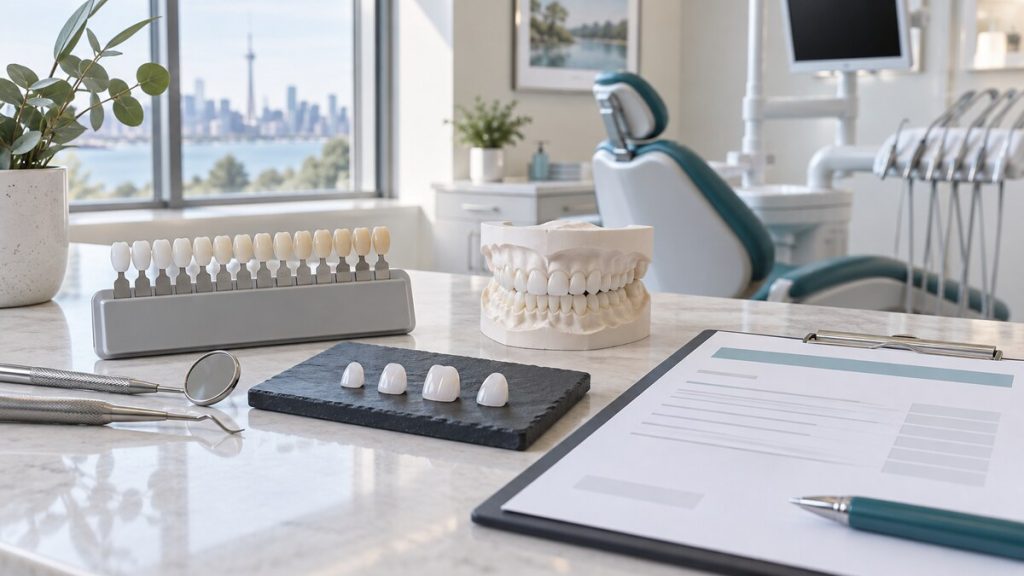
If you are researching veneers cost in Ontario, there is no single fixed price that applies to every patient. The total cost depends on the type of veneer, the number of teeth being treated, the complexity of the case, the materials used, fabrication requirements and whether other dental treatment is needed first.
Dentists in Ontario set their own fees. The Ontario Dental Association explains that treatment complexity, appointment time, materials, equipment, staffing and practice expenses can all influence dental fees. The ODA Suggested Fee Guide may be used as a reference, but dentists are not required to charge the amounts listed in the guide.
For that reason, the most useful way to compare veneer costs is to understand exactly what is included in the treatment plan rather than relying only on an advertised price per tooth.
| Cost Factor | Porcelain Veneers | Composite Veneers |
| Material | Custom ceramic or porcelain restoration | Tooth-coloured composite resin |
| Fabrication | Usually involves a separate fabrication stage | Often shaped directly on the tooth |
| Appointments | Usually requires more than one visit | May be completed in fewer visits depending on the case |
| Laboratory involvement | May involve a dental laboratory or other fabrication process | Direct composite treatment generally involves less laboratory work |
| Tooth preparation | A thin layer of enamel is commonly removed | Preparation varies according to the tooth and treatment plan |
| Total fee | Depends on the number of teeth, treatment complexity, materials, appointment time and other care required. | |
What Are Dental Veneers?
Dental veneers are thin restorations attached to the front surface of teeth to change their appearance.
They may be considered for cosmetic concerns such as discolouration, chips, small spaces between teeth, uneven tooth shape or other appearance-related concerns.
The Canadian Dental Association describes two commonly used veneer materials: porcelain and composite resin. Composite resin can often be applied directly to the tooth, while porcelain veneers generally involve tooth preparation, records or impressions and a separate fabrication stage before the final restoration is bonded in place.
Learn more about dental veneers in Orangeville and the treatment options available through U Smile Dentistry.
How Much Do Veneers Cost in Ontario?
There is no mandatory province-wide fee for veneers in Ontario.
Two patients asking for veneers can receive very different estimates because the proposed treatment may involve different materials, numbers of teeth and levels of complexity.
The Ontario Dental Association explains that dentists set their own fees and may use the ODA Suggested Fee Guide as a reference. Fees can vary above or below suggested amounts depending on the individual practice and treatment.
A final veneer estimate usually requires a dental examination because the dentist needs to determine whether veneers are appropriate and what treatment would actually be required.
What Affects the Cost of Veneers?
Several factors can change the overall treatment estimate.
- The veneer material being considered
- The number of teeth being treated
- The amount of tooth preparation required
- The complexity of colour and shape matching
- Appointment time
- Whether laboratory or other fabrication services are involved
- The condition of the teeth and gums before cosmetic treatment
- Whether other dental procedures are required first
This is why comparing only an online “price per veneer” can be misleading. Two estimates may represent substantially different treatment plans.
How Does the Cost of Porcelain Veneers Differ?
Porcelain veneers generally involve several treatment stages.
The dentist first assesses the teeth and gums and determines whether porcelain veneers are appropriate. When treatment proceeds, a thin layer of enamel is commonly removed to create space for the restorations.
Records or impressions are then used to fabricate the veneers. Temporary veneers may be used while the final restorations are being prepared, depending on the treatment plan.
The final porcelain veneers are then evaluated and bonded to the prepared teeth.
Because porcelain treatment can involve additional fabrication stages, materials and appointments, its cost structure differs from direct composite treatment.
For treatment-specific information, see porcelain veneers in Orangeville.
What Affects the Cost of Composite Veneers?
Composite veneers use tooth-coloured resin and can often be shaped directly on the teeth.
The Canadian Dental Association notes that composite resin veneers can often be completed in a single visit, although treatment time and the amount of preparation vary by patient.
The cost can depend on how many teeth are being treated, how much reshaping or resin placement is required, colour matching, bite considerations and the amount of clinical time involved.
A case involving one small cosmetic correction is very different from treating several front teeth with significant changes in size, shape and proportion.
Learn more about composite veneers in Orangeville.
Porcelain Veneers vs Composite Veneers: Which Costs More?
The treatment processes are different, so the fees may also differ.
Porcelain veneers commonly involve a custom fabrication stage and multiple visits. Composite veneers can often be created directly on the tooth and may involve fewer treatment stages.
However, cost alone should not determine which material is appropriate. The dentist also needs to consider the condition of the tooth, available enamel, bite, cosmetic goals, maintenance requirements and other clinical factors.
The more useful comparison is not simply “which is cheaper?” but whether each option is suitable for the tooth and what the complete treatment plan includes.
Does the Number of Veneers Affect the Total Cost?
Yes. The number of teeth being treated can have a significant effect on the overall treatment estimate.
Treating one tooth requires a different amount of material and appointment time from treating several teeth.
When several visible teeth are involved, treatment planning may also need to consider symmetry, tooth proportions, colour, the relationship between neighbouring teeth and how the teeth appear when speaking and smiling.
A single veneer may also require careful colour matching with untreated natural teeth around it.
For these reasons, the number of veneers is only one part of the total cost calculation.
Can Other Dental Treatment Increase the Total Cost?
Yes. Cosmetic treatment generally should not be used to conceal untreated dental disease.
The Canadian Dental Association notes that veneers may not be appropriate when there is untreated decay or gum disease, insufficient enamel for bonding, or when a large portion of a tooth is missing and another type of restoration may be more appropriate.
Grinding or clenching can also affect treatment planning because these forces may damage veneers.
If the examination identifies another dental condition that should be treated first, that treatment may represent a separate fee from the veneer treatment itself.
Are Laboratory Fees Included in Porcelain Veneer Costs?
That depends on how the treatment estimate is structured.
Porcelain veneers commonly involve a separate fabrication stage. If commercial laboratory services or other external fabrication services form part of the treatment, ask whether those charges are included in the quoted amount or listed separately.
The Ontario Dental Association recommends asking for treatment and fee information before proceeding with dental care. When applicable, patients can also ask for estimates related to professional and laboratory charges.
A written estimate makes it easier to understand what the proposed fee actually includes.
Why Can Online Veneer Prices Be Misleading?
Two online prices may describe very different treatment.
One quote may refer only to the veneer itself. Another may include the consultation, preparation, provisional restorations, fabrication and follow-up appointments.
The materials may also be different. A quote for direct composite veneers should not automatically be compared with a quote for custom porcelain veneers as though they represent the same procedure.
Before comparing estimates, ask:
- Which veneer material is being proposed?
- How many teeth are included?
- What tooth preparation is required?
- Is a separate fabrication or laboratory stage involved?
- Are provisional restorations needed?
- What follow-up appointments are included?
- Could other dental treatment be required first?
- Which services would involve additional fees?
Considering Veneers in Orangeville?
Contact U Smile Dentistry to request an assessment. A dentist can examine your teeth and gums, discuss whether veneers may be appropriate and provide an estimate based on the treatment being considered.
Does Dental Insurance Cover Veneers?
Coverage depends on the individual dental benefit plan, but veneers are often considered cosmetic treatment.
The Canadian Dental Association notes that bonding and veneers are frequently considered cosmetic services and may not be covered by dental benefit plans.
Dental plans vary substantially. The Ontario Dental Association recommends reviewing your own plan because treatment eligibility, reimbursement percentages, annual limits and other restrictions are determined by the plan contract.
If available, a predetermination or pre-treatment estimate can help clarify whether your dental plan is expected to contribute toward any part of the proposed treatment.
Coverage and clinical suitability are separate issues. A dental plan does not determine which treatment is appropriate for your teeth.
Does the Canadian Dental Care Plan Cover Veneers?
No. Under the current 2026 Canadian Dental Care Plan Dental Benefits Guide, composite and ceramic veneers are excluded from CDCP coverage.
Cosmetic treatment is also listed among the services that fall outside the scope of the CDCP.
This means patients should not expect the CDCP to pay for porcelain or composite veneer treatment.
Other dental treatment that is required to treat disease or restore damaged teeth may have different CDCP rules and should be assessed separately from cosmetic veneer treatment.
Are Porcelain Veneers More Cost-Effective Than Composite Veneers?
There is no single answer that applies to every patient.
Composite and porcelain veneers involve different materials, treatment processes and maintenance considerations. An option with a lower initial fee is not automatically the better long-term choice, and a higher-fee treatment is not automatically more appropriate.
The decision should consider the condition of the teeth, available enamel, appearance goals, bite forces, treatment complexity and what future maintenance may be required.
Your dentist can explain the advantages and limitations of the options that apply to your individual case.
How Long Do Veneers Last?
There is no fixed lifespan that applies to every veneer.
How long a veneer remains clinically acceptable can depend on the material, preparation, quality of the supporting tooth, bite forces, grinding or clenching, oral hygiene, trauma and other individual factors.
Porcelain generally resists staining better than composite resin, but no veneer should be described as permanent or guaranteed to last a specific number of years.
Regular dental examinations allow the dentist to assess the veneer margins, underlying teeth, gums and bite over time.
Can Veneers Be Replaced?
Yes. A veneer can be replaced when clinically necessary, but replacement still involves dental treatment of the underlying tooth.
A veneer may need assessment if it chips, fractures, becomes loose, develops a problem at the margin or if the supporting tooth develops decay or another condition.
The appropriate next step depends on what has happened to both the restoration and the tooth underneath it.
Do not assume that every cosmetic defect automatically requires complete veneer replacement. The dentist should assess the restoration before recommending treatment.
Are Veneers Reversible?
Porcelain veneer treatment that requires enamel removal should generally be considered irreversible because enamel that has been removed does not grow back.
The Canadian Dental Association notes that veneers are not reversible when enamel has been removed beneath them.
Composite treatment may require a different amount of tooth preparation depending on the case, so the word “reversible” should not be applied broadly without knowing exactly how the tooth will be treated.
Before agreeing to veneer treatment, ask how much natural tooth structure will be altered and what future treatment the tooth may require.
Veneers vs Dental Bonding: Which May Be Better for Small Changes?
For a small chip, minor gap, limited reshaping or another localized cosmetic concern, dental bonding may sometimes be considered instead of a veneer.
Dental bonding uses tooth-coloured composite resin and is commonly used for smaller repairs. Veneers cover the front surface of the tooth and may be considered when a broader change in colour, shape, proportion or appearance is being planned.
The appropriate option depends on the individual tooth and treatment goal rather than which treatment has the lower advertised fee.
For a more detailed comparison, read our dental bonding vs veneers guide.
What Should Be Included in a Veneer Treatment Estimate?
A useful written estimate should make it clear what treatment you are agreeing to before treatment begins.
Ask whether the estimate includes:
- The type of veneer material
- The number of teeth being treated
- Tooth preparation
- Diagnostic records or impressions
- Provisional restorations when required
- Fabrication or applicable laboratory-related charges
- Final bonding or placement
- Follow-up care related to the treatment
- Any other dental procedures recommended before veneer treatment
The Ontario Dental Association notes that treatment estimates are typically based on an examination because dental care needs are individual and treatment plans can differ between patients.
Questions to Ask Before Choosing Veneers
- Why are veneers being recommended for these teeth?
- Would porcelain or composite be considered, and why?
- How much natural enamel would need to be removed?
- Are there alternatives such as bonding, whitening or orthodontic treatment?
- Do I have decay, gum disease or other dental conditions that should be treated first?
- What is included in the treatment estimate?
- Are any fabrication or laboratory-related charges listed separately?
- What maintenance could be required after treatment?
- What could happen if a veneer chips, fractures or needs replacement?
Veneer Costs in Orangeville
U Smile Dentistry provides cosmetic dental services in Orangeville, including porcelain and composite veneer options.
The appropriate treatment and fee depend on the condition of your teeth, the number of teeth being considered, the material selected and the treatment required for the individual case.
Rather than relying on a generic online price, a dental assessment can determine whether veneers may be appropriate and provide a treatment estimate based on the care being proposed.
You can also review our guides to different types of dental veneers, porcelain veneers and composite veneers.
Contact U Smile Dentistry at (519) 307-6300 or request an appointment online.
Frequently Asked Questions About Veneer Costs
How much do veneers cost in Ontario?
There is no single mandatory price for veneers in Ontario. Dentists set their own fees, and the total cost depends on factors such as the veneer material, number of teeth, treatment complexity, appointment time, fabrication requirements and any additional dental care required.
Are porcelain veneers more expensive than composite veneers?
The treatment processes differ, so the fees may also differ. Porcelain veneers generally involve a separate fabrication process and multiple visits, while composite resin may often be applied directly to the teeth. An individual treatment estimate is more useful than assuming one material always has a particular price relationship to the other.
Does dental insurance cover veneers?
Veneers are often considered cosmetic and may not be covered by dental benefit plans. Coverage varies by plan, so patients should confirm their specific benefits and limitations with their plan administrator.
Does the CDCP cover porcelain or composite veneers?
No. The current Canadian Dental Care Plan Dental Benefits Guide lists composite and ceramic veneers as exclusions, so they are not eligible for CDCP coverage.
Do veneers require enamel removal?
Porcelain veneers commonly require removal of a thin layer of enamel. The amount of preparation for composite treatment varies depending on the tooth and treatment plan.
Can I get an accurate veneer price without an examination?
A general fee may not reflect the treatment you actually need. An examination allows the dentist to assess the teeth and gums, determine whether veneers are appropriate and identify any treatment that may be required before a final estimate is prepared.
Is the cheapest veneer option always the best value?
No. Cost is only one consideration. Material choice, tooth condition, preparation, appearance goals, bite forces, maintenance and the expected treatment process should also be discussed before choosing an option.
Sources Reviewed
- Ontario Dental Association — Dental Costs Explained
- Ontario Dental Association — Dental Treatment Estimates
- Canadian Dental Association — Bonding & Veneers
- Government of Canada — Canadian Dental Care Plan Dental Benefits Guide, effective April 1, 2026


