
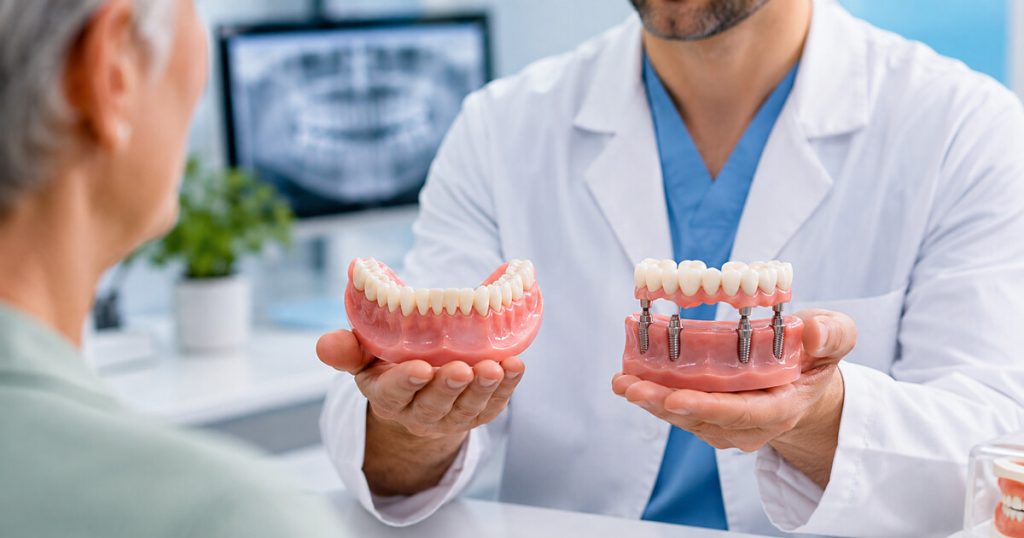
Traditional dentures and implant-supported dentures can both replace missing teeth, but they rely on different forms of support.
A traditional complete denture rests on the gums and underlying tissues. An implant-retained overdenture is removable but connects to dental implants placed in the jaw. Fixed full-arch implant restorations are different again: they remain attached to the implants and are normally removed only by a dental professional.
None of these options is automatically right for everyone. The appropriate treatment depends on the number of missing teeth, the condition of the gums and jawbone, general health, ability to maintain the restoration, treatment goals and budget.
What Are Traditional Dentures?
Traditional dentures are removable appliances used to replace missing teeth.
A complete denture replaces all teeth in an upper or lower arch. A partial denture replaces several missing teeth while working around the natural teeth that remain.
Conventional complete dentures are generally made after the teeth have been removed and the gums and jaw tissues have healed. The denture is shaped to rest on the tissues covering the jaw.
Because a traditional denture is supported by the gums rather than implants, its fit can change as the mouth and jaw tissues change. Follow-up visits, adjustments, relines or eventual replacement may therefore be needed.
What Are Implant-Supported Dentures?
The term implant-supported denture is often used broadly, but it can refer to more than one type of restoration.
Removable Implant Overdenture
An implant overdenture is removable. It connects to dental implants through attachments that help retain the denture while it is being worn.
The Canadian Dental Association describes an overdenture as a removable denture that fits over remaining natural teeth or dental implants. When implants are used, the overdenture attaches to them rather than relying only on the gums for retention.
The patient can remove this type of denture for cleaning.
Fixed Full-Arch Implant Restoration
A fixed full-arch restoration is attached to implants and is not removed by the patient each day. It may replace all teeth in an upper or lower arch.
Although people sometimes call this a fixed denture, its treatment process, design, cleaning requirements and cost differ from those of a removable implant overdenture.
A dentist must identify exactly which type of implant restoration is being discussed before meaningful comparisons can be made.
Traditional Versus Implant-Supported Dentures at a Glance
The table describes general differences. An individual treatment plan may involve additional steps or different maintenance requirements.
| Factor | Traditional denture | Removable implant overdenture | Fixed full-arch implant restoration |
| Main support | Gums and oral tissues | Dental implants and oral tissues | Dental implants |
| Removed by patient | Yes | Yes | Normally no |
| Implant surgery required | No | Yes | Yes |
| Daily cleaning | Denture and oral tissues | Denture, attachments, implants and oral tissues | Restoration, implants and tissues beneath it |
| Treatment timeline | Usually shorter than implant treatment | Includes implant placement and healing | Includes implant placement, healing and restorative stages |
| Bone requirement | Does not require bone for implant placement | Adequate bone or additional treatment may be required | Adequate bone or additional treatment may be required |
| Future maintenance | Adjustments, relines, repairs or replacement | Denture and attachment maintenance | Professional maintenance and possible restoration or component repairs |
| CDCP implant coverage | Some conventional dentures may be eligible, subject to plan rules | Implant-supported dentures and implant procedures are excluded | Implant-related procedures are excluded |
Which Option Is More Stable?
A traditional denture relies on its fit against the gums, the shape of the jaw and the surrounding muscles. Some patients adapt well, while others experience movement or difficulty retaining a lower complete denture.
An implant overdenture attaches to implants, which can reduce movement compared with a denture supported only by the gums. A fixed full-arch restoration is supported by implants and remains attached during daily use.
Greater retention does not eliminate the need for careful treatment planning. The number and location of implants, the restorative design, the bite and the condition of the supporting tissues all affect how the restoration functions.
Request a Tooth-Replacement Assessment
U Smile Dentistry provides denture services and dental implant consultations in Orangeville. An in-person assessment is required to compare treatment options.
Do Implant-Supported Dentures Feel More Like Natural Teeth?
Implant-supported restorations may provide a firmer foundation than a conventional denture. Dental implants are placed in the jawbone and can support crowns, bridges or dentures.
However, an implant-supported restoration is still an artificial prosthesis. It does not recreate natural teeth, natural ligaments or normal sensation exactly.
The experience also differs between a removable overdenture and a fixed full-arch restoration. Patients should ask how much of the restoration will cover the gums or palate, whether it will be removable and how it will need to be cleaned.
Who May Be Considered for Dental Implants?
Implant treatment requires an individual assessment.
The Canadian Dental Association identifies general health, healthy gums and sufficient jawbone as important considerations. When the available bone is inadequate, bone grafting may sometimes be considered. Dental X-rays and other diagnostic information are used to determine whether implants may be appropriate.
- the condition of the gums;
- the amount and location of available bone;
- untreated tooth decay or infection;
- medical history and medications;
- smoking or nicotine use;
- the patient’s bite;
- ability to maintain daily oral hygiene;
- expectations for function, appearance and removability.
A recommendation cannot be made from a website description alone.
Does Implant Treatment Require Surgery?
Yes. Dental implants are surgically placed in the jawbone.
Healing is then required before or during the restorative stages, depending on the treatment plan. The complete process may involve several appointments and can take months, particularly when extraction, grafting or staged treatment is required.
Possible implant-related complications include infection, injury to surrounding tissues, numbness, implant looseness or failure, difficulty cleaning around the implant and problems with restorative components. These risks vary by patient and treatment and should be reviewed during informed consent.
Traditional dentures do not require implant surgery, although tooth extraction or other dental treatment may still be needed before the denture is made.
What Happens If There Is Not Enough Bone?
The jaw must have adequate bone in the appropriate locations to support implants.
When the bone has reduced in height, width or density, the dentist may discuss grafting, an alternative implant design, a different restorative plan or a non-implant option. Bone grafting can add treatment stages and healing time and is not appropriate or necessary in every case.
A conventional denture may still be considered when implant treatment is not suitable or not desired, although the shape of the jaw can also affect how well a conventional denture is retained.
How Are Traditional Dentures Cleaned?
Complete and partial dentures should be cleaned every day.
The Canadian Dental Association recommends removing the denture, rinsing away loose food particles and brushing its surfaces with a denture brush or soft-bristled toothbrush and a suitable denture cleaner or mild soap. Regular toothpaste and household cleaners may be too abrasive.
The gums, tongue and any remaining natural teeth also need to be cleaned.
Conventional removable dentures are generally removed overnight to allow the tissues to rest and to prevent the appliance from drying or warping. Follow the instructions given for the specific denture material and design.
How Are Implant-Supported Dentures Cleaned?
A removable implant overdenture must be taken out so that both the denture and the implant attachments can be cleaned.
The implants, gums and spaces around the attachments also require daily care. Your dental provider may recommend specific brushes, flossing aids or other cleaning devices based on the design and your ability to reach the area.
A fixed full-arch restoration requires cleaning beneath and around the restoration because food and plaque can collect where the restoration meets the gums. It cannot be treated as maintenance-free.
Patients with dental implants should follow the oral-hygiene instructions provided by their dental professional, clean the implant and surrounding teeth regularly and attend ongoing dental visits.
Cleaning Reminder
A fixed full-arch restoration still requires daily cleaning beneath and around the restoration, along with ongoing professional dental visits.
Do Implant Dentures Require Repairs or Replacement?
Yes. Implant-supported does not mean permanent or maintenance-free.
The denture teeth and base can wear or become damaged. Retentive inserts, clips, screws and other components may loosen or wear and require adjustment or replacement. Fixed and removable restorations may also need repair or refurbishment over time.
The implants, surrounding gums and bone need regular monitoring as well.
Traditional dentures also have a limited service life. Changes in the mouth can affect their fit, and they may need adjustment, relining, repair or replacement. Regular dental visits allow the fit and condition of a denture to be assessed.
Which Option Costs More?
Implant-supported treatment generally involves more components and treatment stages than a traditional denture.
The total estimate may include:
- examinations and diagnostic imaging;
- tooth removal where required;
- bone grafting or other preparatory procedures;
- implant surgery;
- temporary teeth or dentures;
- implant attachments or abutments;
- the final removable or fixed restoration;
- maintenance and replacement of worn components.
Dental implants can cost more than other forms of tooth replacement and may not be covered by every dental plan.
Traditional dentures may involve fewer surgical stages, but their cost still depends on the type of denture, materials, laboratory work, remaining teeth, extractions and follow-up care.
Request a written treatment plan that separates the stages, inclusions, expected maintenance and possible additional procedures.
Does the Canadian Dental Care Plan Cover Implant-Supported Dentures?
No. The current Canadian Dental Care Plan Dental Benefits Guide states that complete and partial dentures supported by implants, along with all implant-related procedures, are excluded from CDCP coverage.
The CDCP may cover certain conventional complete, immediate, overdenture and partial-denture services, subject to eligibility, frequency limits, preauthorization and other plan rules. An overdenture supported by remaining natural teeth should not be confused with an implant-supported overdenture.
Patients should ask the clinic for an estimate and confirm which parts of a proposed treatment are eligible before proceeding.
Are Implant-Supported Dentures Always Better?
No.
An implant-supported option may be attractive to someone who wants additional retention and is medically and dentally suitable for implant surgery. A traditional denture may be more appropriate for someone who does not want surgery, cannot undergo implant treatment or prefers a less complex treatment process.
A fixed restoration may suit one patient, while another may prefer a removable overdenture because it can be taken out for cleaning.
The better option is the one that appropriately balances:
- oral and general health;
- available bone;
- surgical risk;
- cleaning ability;
- expected function;
- removability preferences;
- treatment time;
- maintenance requirements;
- cost and coverage.
Questions to Ask During a Tooth-Replacement Consultation
Bring these questions to your appointment:
- Am I comparing a traditional denture, removable implant overdenture or fixed full-arch restoration?
- What supports the proposed restoration?
- Will I remove it myself?
- How many treatment stages are expected?
- Is implant surgery appropriate for my health and oral condition?
- Is additional imaging or bone grafting being considered?
- What temporary teeth will I use during treatment?
- How will I clean beneath and around the restoration?
- What components may need maintenance or replacement?
- What is included in the estimate?
- What is not included?
- Which parts may be eligible under my dental plan or the CDCP?
- What alternatives should I consider?
Clear answers to these questions are more useful than choosing an option based only on a marketing name.
Comparing Tooth-Replacement Options in Orangeville
U Smile Dentistry provides denture services and dental implant consultations in Orangeville. Suitability, treatment stages and costs depend on an in-person clinical assessment.
An assessment can help determine whether a conventional denture, an implant-supported option or another tooth-replacement approach should be considered.
The availability of a specific removable or fixed implant restoration must be confirmed directly with the clinic before treatment is planned.
FAQ
Can a traditional denture be converted into an implant-supported denture?
Sometimes an existing denture can be modified for use with implant attachments, but not every denture has the required fit, strength, space or design. In other cases, a new overdenture is needed. This can only be determined after examining the denture, tissues and implant plan.
Are implant-supported dentures removable?
Some are and some are not. An implant overdenture is removed by the patient for cleaning. A fixed full-arch implant restoration remains attached and is normally removed only by a dental professional.
How many implants are needed for an implant denture?
The number depends on the arch, available bone, implant locations, restorative design and whether the final restoration will be removable or fixed. A specific number should not be recommended without diagnostic assessment and treatment planning.
Can implant-supported dentures be completed in one day?
Some patients may receive a temporary restoration on the day implants are placed, but this does not mean all surgical, healing and final restorative stages are finished that day. Eligibility depends on the clinical situation and implant stability.
Do implants prevent all jawbone loss?
Implants may help preserve bone around the implant sites, but they do not stop every age-related or disease-related change in the jaws. Ongoing oral hygiene and professional monitoring remain necessary.
Do implant dentures last for life?
No dental implant, denture or restorative component can be guaranteed to last for life. The implants, attachments, denture teeth and restorative materials have different maintenance and replacement needs.
Does the CDCP cover implant dentures?
No. Implant-supported complete and partial dentures and implant-related procedures are excluded under the current CDCP Dental Benefits Guide. Some non-implant removable denture services may be eligible under separate plan rules.
Request a tooth-replacement assessment with U Smile Dentistry in Orangeville to discuss whether a conventional denture, removable implant overdenture, fixed full-arch restoration or another option should be considered.


