10 Common Types of Dental Restoration
When a tooth is decayed, cracked, worn down or missing, dental restoration is how a dentist repairs it — or replaces it — so you can bite, chew and speak comfortably again. Restorative treatments focus on health and function first: they stop damage from getting worse, rebuild what is left of the tooth, and fill the gaps left by teeth that could not be saved.
There is no single “right” restoration for everyone. The honest answer depends on how much healthy tooth is left, where the damage is, and the condition of the surrounding teeth and gums. This guide walks through the 10 common types of dental restoration we provide as part of restorative dentistry in Orangeville at U Smile Dentistry, what each one repairs, and when it is usually used.
1. Dental Fillings
A filling is the most common — and usually the smallest — restoration. After the decayed part of the tooth is removed, the cleaned space is filled with a tooth-coloured material that hardens in place and restores the tooth’s shape. Fillings are used for cavities and for small areas of damage caught early.
A filling only works when enough healthy tooth remains to hold it. If the damage is large, a filling can crack or fall out, and a stronger restoration such as an inlay, onlay or crown is the safer choice. You can read more about dental fillings and what to expect from the appointment.
2. Dental Crowns
A crown is a custom-made cap that covers the whole visible part of a tooth. Dentists recommend crowns when a tooth is too weak to hold a filling — after a large cavity, a crack, heavy wear, or a root canal — because the crown holds the tooth together and takes the pressure of biting.
Crowns are made to match the shape and colour of your natural teeth. The trade-off is that some healthy tooth structure is shaped away to make room for the cap, so a crown is chosen when the tooth genuinely needs that protection, not for small repairs. Learn more about dental crowns.

3. Inlays
An inlay is a custom-made piece — usually porcelain or composite — that fits into the chewing surface of a back tooth, inside the cusps (the raised points of the tooth). It sits between a filling and a crown in size: it repairs damage that is too large for a filling to hold reliably, but not so large that the tooth needs to be fully capped.
Because an inlay is made to fit one specific cavity, it can be a strong, well-sealed repair that preserves more of your natural tooth than a crown would. U Smile offers inlays and onlays as part of its restorative care.
4. Onlays
An onlay is the inlay’s bigger sibling. It covers one or more of the tooth’s cusps as well as the surface between them, which is why it is sometimes called a “partial crown.” Onlays are used when damage has reached the edges of the tooth but the tooth is still healthy enough to avoid a full crown.
Like inlays, onlays are custom-made for your tooth and bonded in place. They are a conservative option: more of the natural tooth is kept than with a crown, while the weak or broken parts get proper protection.
5. Dental Bonding
Bonding uses tooth-coloured composite resin, applied and shaped directly on the tooth, then hardened with a special light. In restorative care, bonding repairs chipped teeth, small cracks, worn edges and minor damage after a knock or accident — it rebuilds what was lost without removing much healthy tooth.
Bonding is one of the simpler restorations, but it is not the strongest. The resin can stain over time and is more likely to chip than porcelain, so it is usually chosen for small repairs and front teeth rather than heavy chewing surfaces. See how dental bonding works.

6. Root Canal Therapy
When decay or a crack reaches the pulp — the soft tissue inside the tooth — the tooth becomes infected and painful. Root canal therapy removes the infected pulp, cleans and seals the inside of the tooth, and saves the natural tooth instead of removing it. The tooth is then usually protected with a crown, because a treated tooth becomes more brittle.
A root canal is a restoration because its goal is to keep your own tooth working. It is not always possible: if the tooth is fractured below the gum or too little structure remains, removal and a replacement may be the healthier option, and your dentist will tell you honestly if that is the case. More about root canal therapy.
7. Dental Bridges
A bridge replaces one or more missing teeth in a row. It is held in place by crowns on the healthy teeth at either side of the gap (or by implants), with artificial teeth suspended between them. A bridge restores chewing, keeps neighbouring teeth from drifting into the gap, and is fixed in place — you do not remove it.
The honest caveat: a traditional bridge means the supporting teeth must be shaped for crowns even if they are healthy. That is one reason implants are sometimes recommended instead. Read more about dental bridges.
8. Dentures
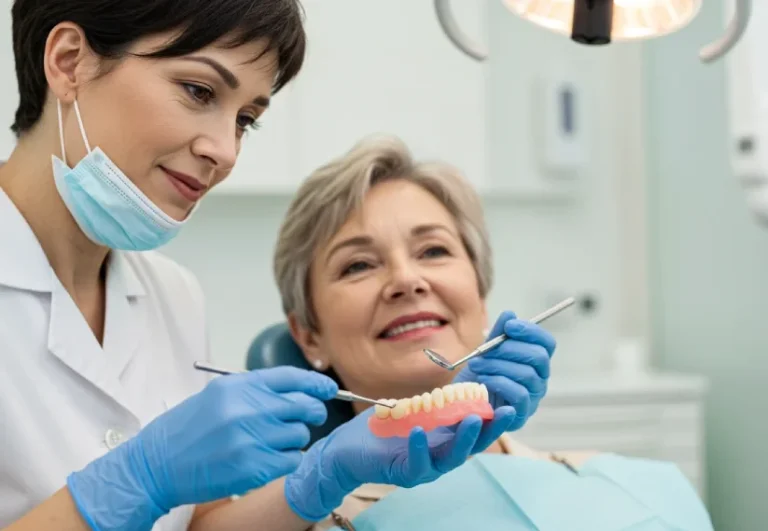
Dentures are removable replacements for missing teeth. A partial denture replaces several teeth and clips around the ones that remain; a complete denture replaces a full arch when no natural teeth are left. Modern dentures are made to look natural and to restore everyday eating and speaking.
Dentures take some getting used to: there is an adjustment period, and because the jawbone slowly changes shape over time, dentures may need relining or replacing to keep fitting well. They remain a practical, non-surgical way to replace many teeth at once. Learn more about dentures.
9. Dental Implants and Implant-Supported Restorations
A dental implant is a small titanium post placed in the jawbone to act as an artificial tooth root. Once it has fused with the bone, it can support a crown, a bridge, or even a full denture — this is the restoration built on top, and it is planned together with the implant itself. Implants are the only replacement that does not rely on neighbouring teeth for support, and they help slow the bone loss that follows tooth loss.
They are not right for everyone, and they are not instant: healing takes time, enough healthy bone is needed (sometimes with grafting first), and your dentist will assess your health and habits before recommending them. More about dental implants.

10. Full-Mouth Reconstruction
Full-mouth reconstruction is not one treatment — it is a planned combination of the restorations above, used when many teeth are damaged, worn or missing at the same time. It may involve crowns, implants, bridges and other treatments in stages, rebuilding both the function and the appearance of the whole mouth.
Because every case is different, reconstruction starts with a complete assessment and a written plan that you go through with your dentist before anything begins. It is the most involved option on this list, and it is reserved for mouths that genuinely need comprehensive repair. It is planned as part of restorative dentistry at our Orangeville clinic.

How Do You Know Which Restoration You Need?
In most cases, you do not have to decide alone — and you should not have to. The deciding factor is how much healthy tooth is left and whether the tooth can be saved. At an assessment, your dentist examines the tooth, takes X-rays if needed, and explains the realistic options, including what happens if you wait. If a tooth cannot be saved, that will be part of the conversation too, along with replacement options such as a bridge, denture or implant.
A Note About CDCP Coverage
Some restorative treatments — such as fillings, crowns, root canal therapy and dentures — may be covered for eligible patients under the Canadian Dental Care Plan (CDCP). Coverage is confirmed only after an eligibility and coverage assessment, some services require preauthorization, and the CDCP fee guide may not cover the full fee. Dental implants are not part of standard CDCP coverage. If you are a CDCP patient, ask our team to confirm what applies to your treatment plan before treatment begins.
Frequently Asked Questions About Dental Restoration
What is dental restoration, in simple terms?
It is any treatment that repairs a damaged tooth or replaces a missing one — from a small filling to a full set of dentures. The goal is to restore function (biting, chewing, speaking) and stop further damage, while keeping as much of your natural tooth as possible.
How does a dentist choose between a filling, an inlay/onlay, and a crown?
It depends on how much healthy tooth remains after the decay or damage is removed. Small damage is repaired with a filling; medium damage in a back tooth suits an inlay or onlay; and when a tooth is too weak to hold any of those safely, a crown protects the whole tooth. Your dentist makes this call after examining the tooth and, usually, an X-ray.
Can a badly damaged tooth always be saved?
No — and a trustworthy dentist will tell you when it cannot. A tooth fractured below the gumline, or one with too little healthy structure left, may need to be removed even after root canal therapy. In that case the conversation turns to replacements: a bridge, a denture, or an implant.
How long do restorations last?
It varies with the type of restoration, the material, where it sits in your mouth, and your habits and home care. Fillings, crowns and other restorations commonly serve for years — often a decade or longer — but none of them are permanent, and all of them need regular checkups so wear or new decay is caught early.
Does the CDCP cover restorative treatments?
For eligible patients, the CDCP may cover treatments such as fillings, crowns, root canal therapy and dentures, subject to the plan’s rules and fee guide; some services need preauthorization before treatment. Coverage is confirmed after an assessment of your eligibility and your specific treatment plan — it should never be assumed in advance. Dental implants are not part of standard CDCP coverage.
What happens at a restoration consultation?
Your dentist examines the problem tooth (and the teeth around it), takes X-rays if needed, and explains which restorations are realistic for your case, with the pros and cons of each. You leave with a treatment plan; the cost of your specific treatment is confirmed by your dentist at your visit, after the assessment, because it depends on what the examination finds.
References
The guidance in this article reflects Canadian dental practice and patient-education resources from the Ontario Dental Association, the Canadian Dental Association and the Royal College of Dental Surgeons of Ontario.
Book a Consultation with Our Restorative Dentist in Orangeville
Damaged, painful or missing teeth rarely fix themselves — and the earlier a problem tooth is assessed, the simpler the restoration usually is. If you need dental restoration in Orangeville, contact U Smile Dentistry at (519) 307-6300 to book an assessment. Our team will examine your teeth, explain your options honestly, and build a plan around what your mouth actually needs.