At some point, most parents look at their child’s smile and wonder. A front tooth is coming in crooked. The top teeth stick out further than they used to. A thumb still goes in the mouth at bedtime, years after you expected it to stop. Is that just how kids’ teeth grow — or is it the kind of thing a dentist should look at sooner rather than later?
This guide is for Orangeville parents in exactly that spot. It walks through the signs that genuinely deserve an early orthodontic assessment, the signs that are usually just normal development, and what an assessment actually involves. One honest note before we start: nothing in this post can tell you whether your child needs braces, and neither can a careful look in the bathroom mirror. Only an in-person assessment can do that. What this guide can do is help you decide when it is time to book one — and what questions to ask when you do.
When should your child first be checked? The age-seven guideline
The Canadian Association of Orthodontists recommends that every child have a first orthodontic check-up no later than age seven. That often surprises parents, because most seven-year-olds still have plenty of baby teeth and are nowhere near ready for braces. That is not really the point of the visit.
By around age seven, the first adult molars and front teeth have usually come in. That gives a dentist enough to work with: how the bite is developing, how the upper and lower jaws are growing relative to each other, and whether the adult teeth still under the gums look like they will have room. Some problems are much simpler to guide at this age, while the jaw is still growing, than to correct later on.
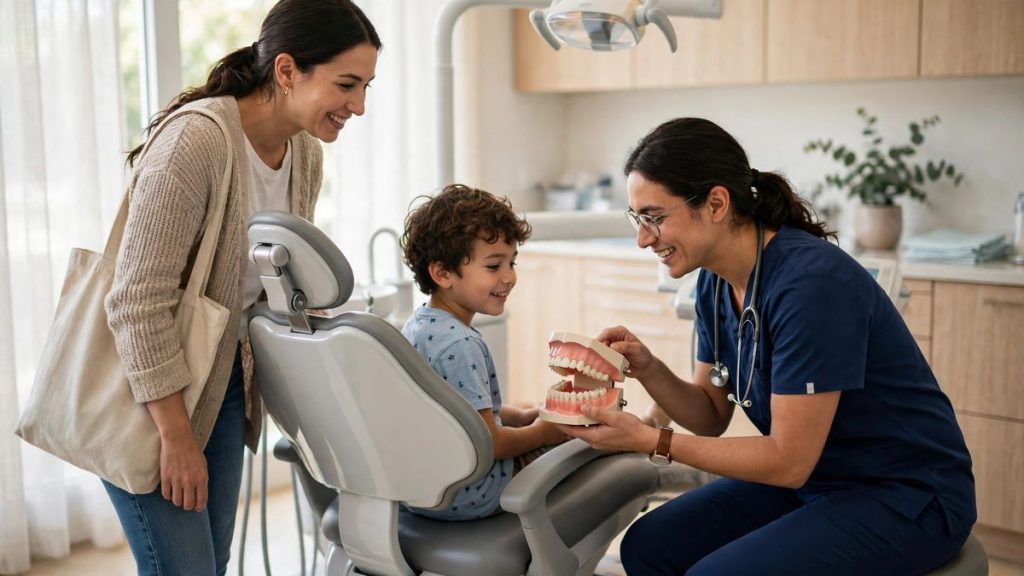
A first check at seven does not mean treatment at seven. For most children, the outcome is a short conversation and a plan to keep watching at regular checkups. And between dedicated assessments, your child’s dentist is already watching for these same signs at every routine visit — an orthodontic assessment is simply a closer, more deliberate look when something specific needs evaluating. At U Smile, that day-to-day watching happens as part of children’s dentistry in Orangeville, so concerns tend to be flagged early rather than discovered late.
The visible signs: crowding, spacing and bite problems
These are the signs you can see in the mirror. None of them automatically means braces — but each one is a reasonable reason to book an assessment instead of guessing.
Crowding and crooked teeth
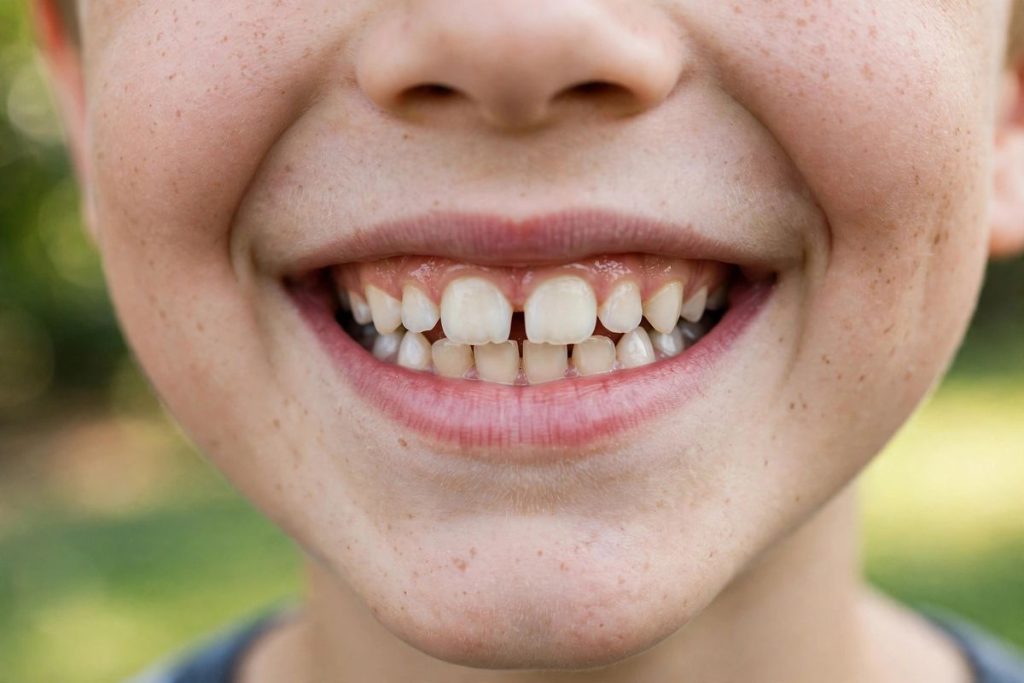
When adult teeth come in rotated, overlapping, or pushed noticeably forward or backward, there may not be enough room in the jaw for all of them. Crowded teeth are also harder for a child to brush and floss properly, which raises the risk of cavities and sore gums in the spots they cannot reach. Mild crowding in the early mixed-teeth years sometimes improves as the jaw grows — which is exactly why an assessment, rather than a guess either way, is the right next step.
Gaps and spacing
Gaps work the other way. Space between baby teeth is normal — even helpful, because adult teeth need more room than baby teeth did. What is worth checking is a very large gap that is not closing as adult teeth arrive, a tooth that seems to be missing entirely, or an adult tooth that has not appeared long after the matching tooth on the other side came through. Sometimes an X-ray shows the tooth is there but off course; sometimes it is genuinely absent. Either way, knowing early gives you more options than knowing late.
Bite problems: overbite, underbite, crossbite, open bite
The bite is how the upper and lower teeth meet, and it is the part parents most often cannot judge on their own. Patterns worth an assessment include an overbite, where the upper front teeth cover the lower teeth deeply or the lower lip tucks behind the upper teeth; an underbite, where the lower teeth or jaw sit in front of the upper teeth — this one deserves an earlier look, because jaw growth is part of the picture; a crossbite, where some upper teeth bite inside the lower teeth, which can lead a child to shift their jaw to one side to chew comfortably; and an open bite, where the front teeth do not meet at all when the back teeth are closed, often connected with thumb-sucking or tongue habits. Bite patterns are about how the jaws grow, not just how the teeth look — and growing jaws are the main reason early assessment exists.
The quieter signs: habits, baby teeth and breathing
Early or late loss of baby teeth
Baby teeth are placeholders — each one holds space for the adult tooth developing underneath it. A baby tooth lost early, to decay or a knock, can let neighbouring teeth drift into the gap and narrow the path the adult tooth needs. A baby tooth that stays in place long past its time can deflect the adult tooth coming in behind or beside it. If your child loses a tooth much earlier than expected, or still has a firm baby tooth well after the same tooth on the other side is gone, mention it at your next visit.
Thumb-sucking and other oral habits
Thumb, finger and soother habits are normal in toddlers. If they continue with real intensity past about age four or five, they can gradually push the upper front teeth forward and narrow the upper jaw, changing how the front teeth meet. How much effect a habit has depends on how often and how firmly a child sucks, not just on the habit itself — which is why a dentist will ask about it rather than assume. Most children stop on their own. If yours has not, an assessment can tell you whether the habit is actually changing anything yet, or whether it is still just a habit.
Mouth breathing, snoring and jaw sounds
A child who breathes through their mouth most of the time, snores regularly, has trouble chewing comfortably, or whose jaw clicks or shifts to one side as it closes is worth mentioning to your dentist. None of these is a diagnosis on its own — mouth breathing has many possible causes, and jaw sounds are common. But breathing and jaw function are connected to how the face and jaws develop, so a dentist who knows about them can watch the right things over time and, where needed, point you to the right next step.
Signs that are usually just normal development
Plenty of things that look worrying are simply how mouths grow. Gaps between baby teeth are normal and usually welcome. Slight flaring of the upper front teeth around ages eight to ten — sometimes called the “ugly duckling stage” — often improves on its own as the canine teeth come in. Adult lower front teeth sometimes appear behind the baby teeth in a double row; in most cases the baby tooth loosens, falls out, and the adult tooth drifts forward on its own. Mild unevenness while teeth are mid-eruption usually settles too.
The honest rule of thumb: normal development tends to improve with time. A sign that is getting more pronounced month after month — crowding increasing, a bite shifting further, a gap that never changes — is the one to have assessed.
What an orthodontic assessment involves
An orthodontic assessment at U Smile is a look-and-talk appointment, not a procedure. Dr. Meysam Jahanmehr examines how your child’s teeth meet, how the upper and lower jaws are growing, and how much room the teeth still coming in are likely to have. The visit usually includes checking which baby and adult teeth are present, how the bite lines up from the front and the sides, and sometimes dental X-rays, so the teeth developing under the gums can be seen as well. You will hear what we found in plain language — including the parts that look completely normal.
It is worth knowing who is doing the assessing. Orthodontic assessments and treatment at U Smile Dentistry are provided by general dentists registered with the Royal College of Dental Surgeons of Ontario (RCDSO). That matters for one of the outcomes below: if your child’s situation is better handled by a specialist orthodontist, we will tell you that directly and make a referral. An assessment also commits you to nothing. It produces information, and what you do with that information is your decision.
What happens next: monitoring, treatment or a referral
There are three honest outcomes from an assessment, and the first is the most common.
Monitoring. For many children, the right answer is “not now — and maybe not ever.” Growth gets rechecked at regular visits, and if things develop normally, no treatment happens at all. Plenty of children who are assessed at seven or eight are monitored for years and never need braces. Watch-and-wait is not a delay tactic; for a growing child, it is often the correct answer.
Treatment. If treatment is recommended, what it looks like depends on what the assessment found. For a younger child it might be a simple appliance that guides growth or holds space for teeth still coming in. For older children and teenagers, treatment more often means braces — and for some teens, clear aligners are an option, depending on the bite problem and on whether the aligners will actually be worn as directed. Our page on braces and clear aligners for teens and adults explains how the main options compare. And if braces do get planned, our guide on how to prepare your child once braces are planned covers the practical side families ask us about.
Referral. Some situations — complex jaw-growth problems, for example — belong with a specialist orthodontist. If that is your child, we will say so and refer you. An honest assessment sometimes concludes that the right next appointment is not with us, and that is a good outcome too: your child ends up in the right chair.
Noticed one of these signs in your child — or are you simply not sure whether what you are seeing is normal? Book an orthodontic assessment and get a direct answer. Call U Smile Dentistry at (519) 307-6300. We are at Unit 3, 328 Broadway in Orangeville. And if the answer turns out to be “let’s just keep an eye on it,” that is a genuinely good answer — you will know your child has actually been looked at, rather than wondered about.
Frequently asked questions
What age should my child first be checked for braces?
The Canadian Association of Orthodontists recommends a first orthodontic check-up no later than age seven, when the first adult molars and front teeth have usually come in. That visit is about spotting developing bite and growth patterns early — it does not mean braces at seven. Most children checked at that age are simply monitored as they grow.
My child still has baby teeth. Can they really be assessed?
Yes — a mix of baby and adult teeth is exactly what an early assessment is designed for. The dentist can see how the bite is forming, whether the teeth still under the gums have room, and whether a baby tooth lost early or kept too long is affecting the teeth around it. Full braces usually wait until more adult teeth are in, but some early guidance only works while baby teeth are still present.
Does every child who gets an assessment end up needing braces?
No. Many children who are assessed are monitored over time and never need treatment at all — their jaws grow, teeth come in, and the concern resolves. Others need treatment only years later, as teenagers. An assessment gives you a factual picture and a timeline to watch, not a commitment to braces.
What are the most common signs a child might need braces?
The ones parents notice most are crowding or overlapping adult teeth, large gaps or a tooth that seems to be missing, and bite patterns such as an overbite, underbite or crossbite. Quieter signs include a baby tooth lost much too early or kept far too long, a thumb-sucking habit that continues past age four or five, and regular mouth breathing. Any of these is a reason to book an assessment — not proof that braces are needed.
Are braces for kids covered by the CDCP?
No. Orthodontic treatment, including braces, is not covered by the Canadian Dental Care Plan (CDCP). Many private dental insurance plans do include some orthodontic coverage for children, and the amount varies a great deal from plan to plan, so it is worth confirming yours before any treatment is planned. U Smile accepts many dental insurance plans, as well as the CDCP for the services it covers, and our team can help you check what your plan includes.
How long do kids usually wear braces?
It depends on what is being corrected and how fast your child is growing. Full treatment for a teenager commonly takes somewhere in the range of one to two years, while a short early phase of treatment in a younger child can be much briefer. Your child’s assessment will include a realistic estimate for their situation — and braces are normally followed by a retainer period to hold the result while the teeth settle.
Can my teenager use clear aligners instead of braces?
Sometimes. Clear aligners can handle many teen cases, but they only work when they are worn for the full recommended time each day, and some bite problems are better treated with braces. Age alone does not decide it — the type of correction needed and your teen’s wear habits do. That is one of the things an assessment sorts out honestly.
What happens if we just wait and do nothing?
Some signs genuinely resolve on their own, and monitoring at regular dental visits is a reasonable middle path for many children. The trade-off is that certain problems — crowding caused by space lost after an early baby-tooth loss, or a crossbite that makes the jaw shift to one side — can become harder to correct once jaw growth slows. An assessment lays out which situation your child is in, so waiting becomes an informed decision rather than a hope.
References
- Canadian Association of Orthodontists — when children should first see an orthodontist: cao-aco.org
- Ontario Dental Association: oda.ca
- Canadian Dental Association: cda-adc.ca
- Royal College of Dental Surgeons of Ontario: rcdso.org
- Government of Canada — Canadian Dental Care Plan: canada.ca