
You’re halfway through braces treatment, your teeth are finally moving into line — and now one tooth has started to ache. Maybe it throbs at night, or bites hurt, or your dentist has spotted a problem on an X-ray and used the words “root canal.” The first question almost everyone asks is the same one: can that even be done with braces on?
In most cases, yes. A root canal with braces works because a root canal treats the inside of a tooth, and braces work on the outside — so the two treatments can usually go ahead without one cancelling the other. This guide explains how a root canal is done around brackets and wires, what (if anything) has to be adjusted, why a painful or infected tooth shouldn’t be left until your braces come off, and how the process differs if you wear clear aligners instead. Decisions about your own tooth are made after an examination and imaging — but you don’t need to choose between saving the tooth and finishing your orthodontic treatment.
- The Short Answer: Yes, Usually — and Braces Stay On
- How a Root Canal Works Around Brackets and Wires
- Does the Wire or a Bracket Need to Come Off?
- What If You Wear Clear Aligners Instead of Fixed Braces?
- What Your Dentist and the Team Treating Your Braces Coordinate
- Timing: Mid-Treatment, or Wait Until the Braces Come Off?
- Signs the Tooth Can’t Wait
- Aftercare With Braces On
- References
- Frequently Asked Questions About Root Canals and Braces
The Short Answer: Yes, Usually — and Braces Stay On
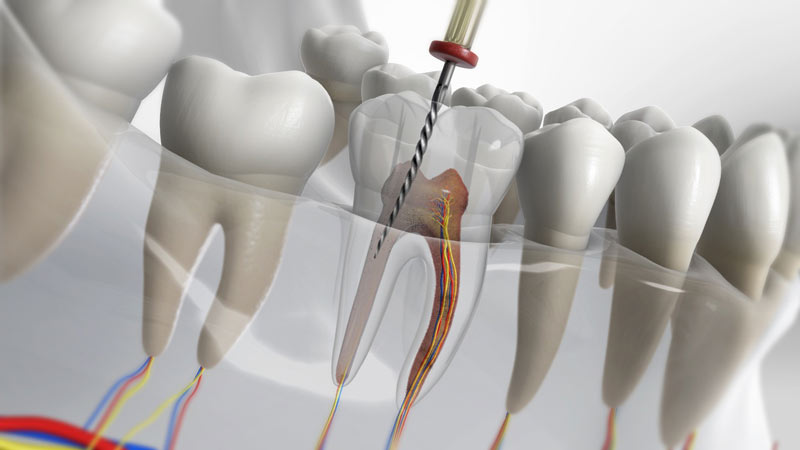
Root canal treatment removes the inflamed or infected pulp — the soft tissue inside the tooth — cleans and disinfects the space, then fills and seals it so the tooth can be kept. None of that requires straight teeth, and none of it requires your braces to come off first. Dentists regularly provide root canal treatment in Orangeville to patients who are partway through orthodontic treatment, and the braces stay on while it’s done.
There are two honest qualifiers. First, “usually” is doing real work in that sentence: your dentist confirms the plan after examining the tooth and reviewing X-rays, because the tooth’s condition — how much healthy structure remains, whether there’s a crack, how complex its roots are — decides how treatment is sequenced. Second, a root canal in braces sometimes needs a small adjustment to the braces themselves, arranged between the two teams treating you. Neither qualifier is a reason to delay being seen: if a tooth is infected, the assessment is the urgent part.
This article covers root canals specifically. For fillings, crowns, extractions and everything else, see our guide to other dental work you can get while wearing braces.
How a Root Canal Works Around Brackets and Wires
A bracket sits on the front surface of the tooth. A root canal is reached from the opposite side: your dentist makes a small opening through the chewing surface of a back tooth, or the back (tongue-side) surface of a front tooth — the side away from the bracket. Through that opening, the pulp is removed, the canals inside the roots are cleaned and shaped, and the space is filled and sealed. The Ontario Dental Association’s overview of common dental procedures describes the procedure the same way: the tooth is opened, the infected tissue is cleaned out, and the space is filled and sealed to prevent further infection.
Two parts of the setup adapt around your braces:
- The rubber dam. A thin sheet called a rubber dam is placed over the tooth to keep it dry and clean during treatment. With braces, the dam is fitted around the bracket and wire, or the wire is lifted out of that one bracket for the appointment so the dam can seal properly.
- The closing restoration. When the root canal is finished, the opening is sealed with a filling. Many root-canal-treated teeth later need a crown for strength; if the tooth is still being moved by your braces, your dentist may place a well-sealed filling now and plan the crown for after the braces come off, so the crown is made for the tooth’s final position. That sequencing decision is part of the coordination described below.
Before treatment starts, the tooth is numbed with local anesthesia, the same as for a filling. Most patients are comfortable during the appointment, and any tenderness afterward is usually managed with over-the-counter pain relief and settles over a few days — your dentist will tell you exactly what to expect for your case.
Does the Wire or a Bracket Need to Come Off?
Usually very little has to change, and nothing has to change permanently:
- The archwire — the wire that runs through all your brackets — may be removed for the appointment, or simply lifted out of the one bracket on the tooth being treated, to give your dentist clear access and room for the rubber dam. It’s put back at the same visit or at a short follow-up; if the office treating your braces needs to re-fit it, the two offices coordinate the timing.
- The bracket itself almost always stays on. Because the root canal is reached from the chewing or tongue-side surface, the bracket on the front of the tooth is rarely in the way. If a bracket did ever need to come off for access, it can be re-bonded afterward — that is the exception, not the routine.
- Elastics and auxiliaries (rubber bands, springs, power chains) that cross the tooth are simply taken off for the appointment and replaced when treatment is done.

None of these adjustments undoes your orthodontic progress. Teeth don’t move measurably during a single appointment, and your orthodontic plan resumes as soon as the wire is back in place.
What If You Wear Clear Aligners Instead of Fixed Braces?
If your orthodontic treatment uses clear aligner treatment rather than fixed braces, a root canal is simpler still — because aligners come out. You remove your trays for the appointment, treatment proceeds exactly as it would for any other patient, and you put the aligners back in afterward.
Two things still need attention. First, tell the team providing your aligners that a root canal is planned: if the tooth receives a filling or later a crown, its shape changes slightly, and aligners are made to fit your teeth precisely — your provider may want to check the fit or adjust your tray sequence. Second, small tooth-coloured attachments bonded to the teeth for aligner grip are handled the same way as brackets: the root canal is reached from the opposite surface, and an attachment rarely needs to be disturbed. Keep wearing your aligners for the hours prescribed each day during healing, unless your dentist advises a short change right after the appointment.
What Your Dentist and the Team Treating Your Braces Coordinate
When a root canal and orthodontic treatment overlap, the clinical work is straightforward — the coordination around it is what makes it smooth. Expect the two teams to share:
- The diagnosis and imaging. X-rays of the troubled tooth go to both offices, so the braces team knows which tooth is being treated and why.
- The appointment sequence. Ideally the wire adjustment (if one is needed) and the root canal happen in an order that means one trip doesn’t undo the other — for example, a root canal booked just before a scheduled wire change.
- The movement plan for that tooth. A tooth that has had a root canal can still be moved orthodontically, but the braces team may adjust the forces on it or the timing of its movement while it heals. They can only do that if they know.
- The final restoration plan. Filling now vs. crown now vs. crown after debonding is agreed in advance, so nothing is built twice.
Your part in the coordination is simple: tell both offices about the other. When you book the root canal, say that you’re in braces and who is treating them; when you next see the braces team, tell them a root canal has been done or is planned. (The Ontario Dental Association’s guide to orthodontic procedures is a useful background read on how orthodontic treatment is structured.)
At U Smile Dentistry, our dentists are general dentists who provide both routine root canal treatment and orthodontic care; if a tooth’s anatomy is unusually complex — curved or calcified canals, a re-treatment, a suspected crack — we may recommend referral to an endodontist, a specialist in root canal treatment, and a certified endodontist practises here in Orangeville. That recommendation, when it happens, is about getting the right hands on a difficult tooth, and your braces treatment continues either way.
Timing: Mid-Treatment, or Wait Until the Braces Come Off?
This is the question behind most searches on this topic, and the answer is: an infected or painful tooth does not wait politely for your orthodontic schedule. The Canadian Dental Association and the Canadian Academy of Endodontics state it plainly in their joint public statement — root canal treatment is a safe, effective way to save a tooth whose pulp is inflamed or infected, and delays caused by worry can cost the tooth.
Here is what waiting can actually mean:
- Infection progresses. An infected pulp doesn’t heal on its own. Left untreated, infection can spread to the bone around the root, cause an abscess and swelling, and destroy the bone that both the tooth and your orthodontic plan depend on.
- Pain escalates. A tooth that aches mildly today can become a severe toothache or an emergency visit — still mid-braces, just on worse terms.
- The tooth may be lost. If the tooth becomes unsavable, it has to be removed — and losing a tooth partway through orthodontic treatment changes the whole plan: spaces, bite and timelines all have to be redesigned around the gap.
- Braces don’t protect the tooth meanwhile. Brackets and wires do nothing to slow decay or infection inside a tooth; if anything, cleaning around them takes more effort, which is one more reason problems found during treatment are dealt with promptly.
The timing that can be flexible is the finishing step: as explained above, a permanent crown is often deliberately deferred until the braces come off, so it’s made for the tooth’s final position. Treating the infection is urgent; finishing the restoration can be sequenced. Your dentist will lay out which parts are which at the assessment.
Signs the Tooth Can’t Wait
Some symptoms mean “book an assessment soon.” The ones below mean “call today”:
- Severe or throbbing tooth pain, or pain that wakes you at night
- Pain when biting or chewing on one tooth, or a tooth that suddenly feels “high”
- Lingering sensitivity to hot or cold that stays after the source is removed
- Swelling of the gum, face or jaw, or a pimple-like bump on the gum near a tooth
- A tooth that has gone noticeably darker than its neighbours
- A bad taste in the mouth from a tooth, or a cracked/broken tooth with pain
These signs can point to pulp inflammation or infection — with or without braces. Call U Smile Dentistry at (519) 307-6300 the same day; if you have facial swelling, fever, or trouble swallowing or breathing, seek emergency dental care or urgent medical care immediately — those symptoms are never a wait-and-see.
Aftercare With Braces On
Recovery from a root canal is usually a matter of days, and braces add only a few specifics:
- Tenderness is normal. The tooth and the area around it may be tender to bite on for a few days while the tissues heal. Over-the-counter pain relief, taken as directed, is usually enough; call the clinic if pain grows instead of easing.
- Chew gently on that side until the tenderness settles, and be careful until the final restoration is in place — a root-canal-treated tooth with a temporary filling is not at full strength.
- Clean carefully around the bracket. After any dental work, braces hygiene matters even more: brush gently around the treated tooth, and use the brushes or floss aids you were shown for cleaning under the wire. Keeping the area clean protects the seal on the tooth.
- Watch the wire and bracket. If the wire was lifted or removed for your appointment, confirm before you leave whether it’s back in place or when it will be re-fitted — and if a bracket feels loose afterward, tell the team treating your braces.
- Keep both sets of appointments. The root canal may need a review, and your orthodontic adjustments continue on schedule. If a check of the treated tooth is advised before a bigger wire change, the two offices will sequence it.
A root canal with braces sounds like a collision between two treatments — in practice, it’s a routine piece of coordination. The braces stay on, the tooth gets treated, and your orthodontic plan continues. What matters is not letting a painful or infected tooth wait for a debonding date that could be months away.
If you have a toothache in the middle of orthodontic treatment in Orangeville, call U Smile Dentistry at (519) 307-6300 or contact U Smile Dentistry to book an assessment. We’ll examine the tooth, review imaging with you, and — if a root canal is the right call — coordinate the plan with whoever is treating your braces, so both treatments stay on track.
References
The guidance in this article reflects Canadian dental practice and patient-education resources from the Ontario Dental Association, the Canadian Dental Association and the Royal College of Dental Surgeons of Ontario (RCDSO). Dentists in Ontario are licensed by the RCDSO, and patients can verify a dentist’s registration on the RCDSO website.
Specific sources drawn on above: the Ontario Dental Association’s patient guidance on common dental procedures (including root canals) and on orthodontic procedures, and the joint public statement on root canal treatment issued by the Canadian Dental Association with the Canadian Academy of Endodontics — linked where they are discussed in the article.
Frequently Asked Questions About Root Canals and Braces
Will a root canal damage my braces?
No — root canal treatment is done on the inside of the tooth and doesn’t require your braces to be damaged or removed. At most, the archwire may be lifted out of the treated tooth’s bracket for the appointment, or elastics crossing the tooth taken off, and those are replaced afterward. Your brackets, and the progress your treatment has made, stay intact. If anything about your braces feels different after the visit — a wire that feels out of place, a loose bracket — mention it to the team treating your braces so it can be checked at your next adjustment.
Do I need my braces removed for a root canal?
No. The full set of braces is never removed for a root canal, and even the bracket on the treated tooth almost always stays on, because the root canal is reached through the chewing surface of a back tooth or the back surface of a front tooth — the opposite side from the bracket. Temporarily removing the archwire, or part of it, is sometimes done to make room for treatment and is reversed right away. Braces are not a reason to postpone treating a tooth that needs a root canal.
What if the painful tooth has a bracket on it?
That’s the normal situation, not a complication. The bracket sits on the front of the tooth while the root canal is accessed from the chewing or tongue-side surface, so the two rarely meet. Your dentist may lift the wire out of that one bracket so a rubber dam can be fitted cleanly around the tooth during treatment, and bond or adjust anything afterward if needed. A bracket on the tooth changes the setup slightly; it doesn’t change whether the tooth can be treated.
Should I call the dentist or the office doing my braces first?
For tooth pain, call a dentist first — pain, swelling, sensitivity and a cracked or darkening tooth are dental symptoms, and only an examination with X-rays will show whether the pulp is inflamed or infected. If the pain is severe, or you have swelling or fever, call the same day. Then tell the office treating your braces what was found and what’s planned, so any wire adjustment or change to the movement plan for that tooth can be coordinated. If one office provides both your general dental care and your braces treatment, one call covers both conversations.
Can I just wait until my braces come off to have the root canal?
If the tooth is infected or its pulp is irreversibly inflamed, waiting is the risky option. An infected pulp doesn’t recover on its own; left for the months a braces timeline can still have to run, the infection can spread to the surrounding bone, form an abscess, and eventually make the tooth impossible to save — and losing a tooth mid-treatment forces your orthodontic plan to be redesigned around the gap. Treating the tooth promptly protects both the tooth and the braces plan. The part that often is scheduled for after the braces come off is the permanent crown, so it can be made for the tooth’s final position.
What if I wear clear aligners instead of braces — is it easier?
Yes, in one practical way: aligners are removable, so you simply take your trays out for the root canal appointment and put them back in afterward — there’s no wire to adjust and no bracket to work around. What still matters is telling the team providing your aligners: if the tooth gets a new filling or later a crown, its shape changes slightly, and aligners fit precisely, so your provider may want to check the fit or adjust your tray plan. Small attachments bonded to the teeth for aligner grip rarely interfere, since the root canal is reached from the opposite surface of the tooth.
Does the CDCP cover a root canal if I’m wearing braces?
The two treatments sit in different places under the Canadian Dental Care Plan (CDCP). Root canal treatment is among the services the CDCP covers for patients who are eligible, with the level of coverage set by the CDCP fee guide after eligibility is confirmed — it should never be assumed to be the full cost. Orthodontic treatment — braces and clear aligners — is not covered by the CDCP, and neither are adjustments to braces made around another procedure. Eligibility for the CDCP is based on criteria including having no access to dental insurance and a family income below $90,000. If you’re a CDCP patient, ask the clinic to confirm how the root canal portion of your care is handled before treatment begins, so the plan is clear in advance.


