
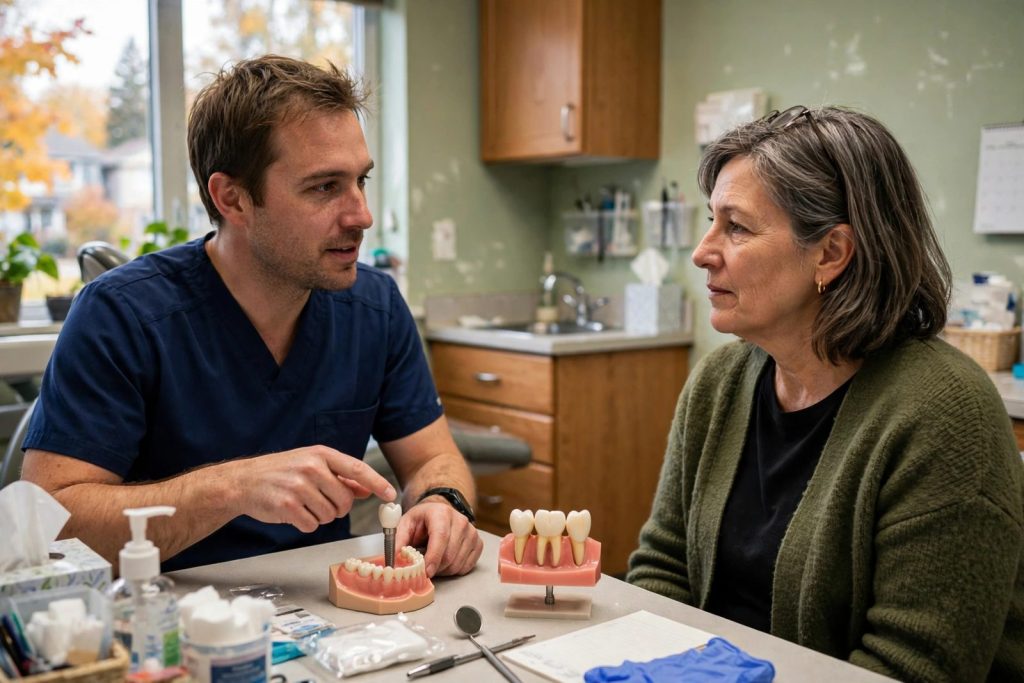
Losing a tooth in Orangeville leaves you with a practical question: how should you replace it? If you are weighing a dental implant vs fixed bridge, you are comparing two well-established options that work in very different ways. Neither one is right for everyone, and the honest answer depends on your bone, your neighbouring teeth, your health, and how you feel about treatment that involves surgery. This guide walks through both options side by side so you can have an informed conversation at your assessment.
A dental implant replaces the root of a missing tooth as well as the visible crown. A fixed bridge replaces only the visible part, and it relies on the teeth on either side of the gap for support. That single difference — a new root in the bone versus support from neighbouring teeth — explains most of the differences in lifespan, care, and who each option suits.
- What a dental implant is
- What a fixed bridge is
- Dental implant vs fixed bridge: side-by-side comparison
- How to choose between an implant and a bridge
- Frequently Asked Questions
What a dental implant is
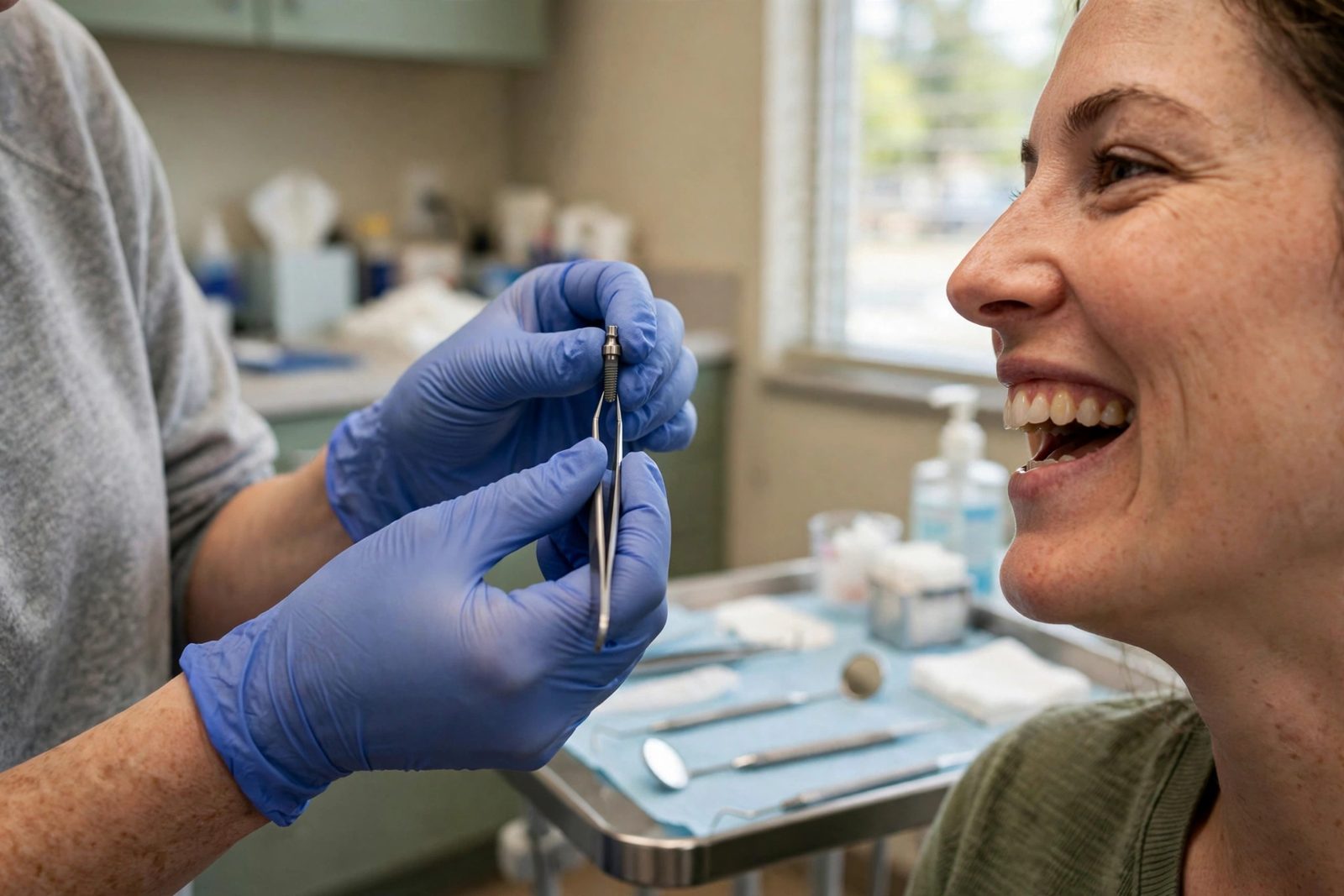
An implant is a small titanium post placed in the jawbone where the tooth root used to be. Over the following weeks and months, the bone fuses with the post in a process called osseointegration. Once that bond is stable, a connector piece and a custom-made crown are attached, so the finished tooth stands on its own. You can read more about the stages involved on our page about dental implants in Orangeville and how implant treatment is planned.
Because an implant involves surgery and a healing period, it is not suitable for everyone. People with uncontrolled medical conditions, heavy smokers, and people whose jawbone has thinned a great deal after tooth loss may need additional treatment first, or may be advised toward a different option. Your dentist will assess bone volume, gum health, and your medical history before recommending it.
What a fixed bridge is
A fixed bridge is a set of joined crowns. The crowns at each end fit over the natural teeth beside the gap — these supporting teeth are reshaped so the crowns can fit over them — and a false tooth suspended between them fills the space. The bridge is cemented in place and does not come out. It restores chewing and appearance without surgery, which is why some patients prefer it.
The trade-off is that healthy neighbouring teeth must be reshaped to hold the bridge, and those supporting teeth then carry extra biting load. If one supporting tooth later develops decay or a root problem, the whole bridge is usually affected. Guidance on caring for crowns and bridges is available from the Ontario Dental Association, and your dental team can explain what applies to your situation.
Dental implant vs fixed bridge: side-by-side comparison
| Factor | Dental implant | Fixed bridge |
|---|---|---|
| What it is / how it works | A titanium post placed in the jawbone acts as an artificial root. After the bone fuses with the post, a crown is attached on top. The replacement tooth stands independently. | Joined crowns cemented over the reshaped natural teeth on either side of a gap, with a false tooth suspended between them. It depends on neighbouring teeth for support. |
| Typical lifespan | In a systematic review by Pjetursson and colleagues (Clinical Oral Implants Research, 2007), implant-supported single crowns had an estimated survival of about 94.5% at 5 years — survival meaning the crown and implant were still in place. A later review by Jung and colleagues (Clinical Oral Implants Research, 2012) reported single implant crown survival of about 96% at 5 years and about 89% at 10 years. Individual results vary with health, habits, and care. | In the same 2007 systematic review series by Pjetursson and colleagues, conventional tooth-supported fixed partial dentures (bridges) had an estimated survival of about 93.8% at 5 years and about 89.2% at 10 years, where survival means the bridge remained in place. The underlying supporting teeth can still develop decay or need root canal treatment over time. |
| Maintenance and care | Brush and clean around the implant crown daily, including cleaning between teeth, and keep regular check-up and hygiene appointments so the gum around the implant can be monitored. Implants cannot decay, but the surrounding gum and bone can become inflamed if plaque builds up. | Brush normally and clean underneath the suspended false tooth daily using floss threaders or interdental brushes, because plaque collects at the gumline under a bridge. The supporting teeth can still decay, so fluoride and regular check-ups matter. |
| Effect on neighbouring teeth and jawbone | Neighbouring teeth are left untouched. Because the implant transmits chewing forces into the jawbone, it helps maintain bone volume in the area where the tooth was lost, although it does not stop bone changes elsewhere. | The neighbouring teeth are reshaped to receive crowns and take on extra load. The bridge does not stimulate the jawbone under the gap, so the bone in that area tends to shrink gradually over time after tooth loss. |
| Who it suits and who it does not | Often suits people with healthy gums, adequate jawbone, and neighbouring teeth that are healthy and unrestored. It may not suit people with certain uncontrolled medical conditions, people who smoke heavily, or cases where bone loss is severe and grafting is not an option or not wanted. | Often suits people who want to avoid surgery, whose neighbouring teeth already have large fillings or crowns, or where implant placement is not medically advisable. It is less suitable when the neighbouring teeth are healthy and untouched, because they must be reshaped, or when the supporting teeth are weak. |
| Number of visits and treatment timeline | Usually several visits spread over a few months: assessment and imaging, implant placement, a healing period while the bone fuses with the post, then fitting of the final crown. Timelines lengthen if bone grafting is needed. | Usually two to three visits over a few weeks: preparation of the supporting teeth and impressions, a temporary bridge while the final one is made, then fitting and cementing of the finished bridge. |
| CDCP coverage | Dental implants are not covered by the Canadian Dental Care Plan (CDCP). If cost coverage matters to your decision, ask the clinic to explain your options before treatment begins. | Fixed bridges are not covered by the Canadian Dental Care Plan (CDCP). Coverage for other treatments depends on the plan rules that apply to you, which the clinic can help you check. |
How to choose between an implant and a bridge
Start with the condition of the teeth beside the gap. If they are healthy and have never been filled, many dentists lean toward the option that leaves them alone. If they already carry large fillings or crowns, using them to support a bridge may make more sense. Next, consider the bone: an implant needs enough healthy jawbone, and your dentist can assess this with imaging. Your overall health, whether you smoke, and how you feel about a surgical procedure and a longer timeline also matter.
Cost is a fair question, but it depends on factors that affect cost such as the number of teeth involved, whether grafting is needed, the materials used, and the condition of the supporting teeth — so a meaningful figure can only come after an in-person assessment. If you would like to talk it through, you are welcome to call U Smile Dentistry in Orangeville at (519) 307-6300 to book an assessment. There is no obligation, and sometimes the right decision is to monitor the gap rather than rush into either option.
Frequently Asked Questions
Does getting a dental implant hurt?
The placement is done with local anaesthetic, and most people manage the days afterwards with over-the-counter pain relief and a soft diet for a short period. We cannot promise an experience without discomfort — some soreness and swelling are normal after surgery — but your dentist will explain what to expect and how to manage it before you decide.
How long does a fixed bridge treatment take from start to finish?
For most people it takes two to three appointments over a few weeks. The first visit prepares the supporting teeth and takes impressions, you wear a temporary bridge in between, and the final bridge is fitted and cemented at a later visit once the dental laboratory has made it.
Can a bridge be replaced with an implant later?
Often, yes. If a bridge eventually fails or a supporting tooth cannot be saved, an implant is sometimes an option, provided there is enough jawbone and your health allows it. Bone can shrink under a bridge over the years, so an assessment with imaging is needed to confirm what is possible in your case.
What happens if I do nothing about a missing tooth?
Teeth beside and opposite a gap can drift or tilt into the space, which can affect your bite and make cleaning harder. The jawbone under the gap also shrinks over time. Some gaps, particularly at the very back, are sometimes monitored instead of replaced — your dentist can tell you whether waiting is reasonable in your situation.
Am I too old for a dental implant?
Age on its own is not usually the deciding factor. What matters more is your general health, the condition of your jawbone and gums, medications you take, and whether you smoke. Many older adults have implants, while some younger patients are not suitable candidates. An individual assessment is the only reliable way to know.
How do I clean under a fixed bridge?
Plaque collects where the false tooth meets the gum. Floss threaders, super floss, or small interdental brushes let you clean under the bridge and around the supporting teeth each day. Your hygienist can show you the technique and check at your regular visits that the area is staying healthy.
Are dental implants or bridges covered by the Canadian Dental Care Plan?
No. Dental implants and fixed bridges are not covered by the Canadian Dental Care Plan. Other dental services may be covered depending on your eligibility under the plan, and the clinic can help you check what applies to you before treatment starts. General information about federal dental programs is available through Health Canada.
What if I grind my teeth at night?
Grinding puts extra force on both implants and bridges and can chip crowns or loosen components over time. If you grind, tell your dentist before choosing — a night guard and certain material choices may be recommended to protect whichever option you pick, and heavy grinding sometimes changes which option is advised.


