
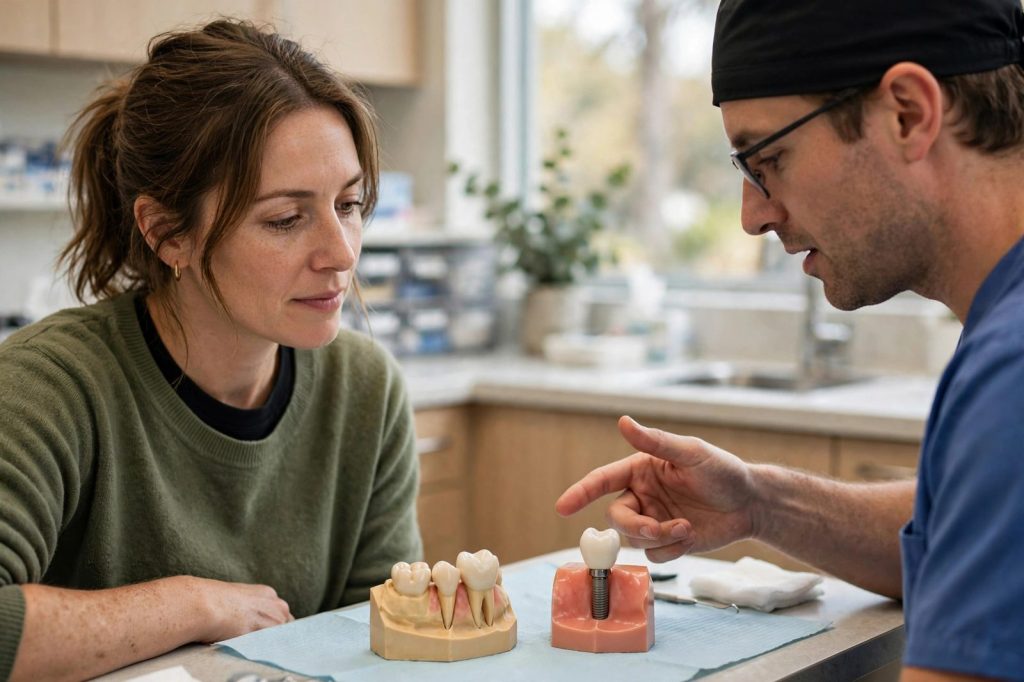
Crown vs implant in Orangeville sounds like one decision, but it is really two different situations. A crown saves a tooth that is still there but weakened. An implant replaces a tooth that is gone, or one that cannot be saved. This guide explains when each applies, where the choice is real, and where it is not — so you can talk it through clearly at U Smile Dentistry. The implant side of the picture is covered in depth on our dental implants in Orangeville page.
What each option is
A dental crown is a cap that covers a natural tooth that has been weakened by a large filling, a crack, or root canal treatment. The tooth’s own root stays in the jaw, and the crown restores its shape and strength. A dental implant is a titanium post placed in the jawbone to stand in for a missing root, with a crown attached on top once the bone has bonded to it. If your tooth can be predictably saved, the comparison ends early: keeping your own tooth is usually the first choice. The real comparison begins when a tooth is badly broken down and its long-term outlook is doubtful.

Side-by-side comparison: crown vs implant
| Question | Crown on your natural tooth | Dental implant |
|---|---|---|
| What it is / how it works | A custom cap cemented over your own prepared tooth; your natural root remains and does the work. | A titanium post in the jawbone replaces the root; a crown is attached to the post after healing. |
| Typical lifespan | Systematic reviews by Sailer, Pjetursson and colleagues report roughly 9 in 10 single crowns still in place at 5 to 10 years, measured as the crown not needing replacement. The tooth underneath — not the crown — is usually what limits long-term success. | Systematic reviews by Pjetursson and colleagues report roughly 9 in 10 single implants still in place and functioning at 10 years. Results depend on bone, gum health and home care. |
| Maintenance and care | Normal brushing and flossing; the edge where crown meets tooth needs particular attention, because decay can start there. | Brush and clean around the implant like a natural tooth, with care at the gumline; regular checkups to monitor bone and gum around it. |
| Effect on neighbouring teeth and jawbone | Neighbouring teeth are untouched, and your own root keeps loading the jawbone naturally. | Neighbouring teeth are untouched. The implant loads the bone in the gap, helping maintain it after a tooth is lost. |
| Who it suits and who it does not | Suits a tooth with a sound root and enough remaining structure, even if the top is badly worn or cracked. It does not suit a tooth with a fractured root, deep decay below the gumline, or too little structure to hold a cap. | Suits a missing tooth, or a tooth that cannot predictably be saved, in a patient with adequate bone and health for a surgical procedure. It may not suit uncontrolled medical conditions or very low bone without grafting. |
| Number of visits and timeline | Usually two visits over a few weeks; if a root canal is needed first, that adds visits before the crown. | Several visits over a few months: placement, healing while bone bonds, then the final crown. |
| CDCP coverage | Crowns may be covered under the CDCP for eligible patients, subject to plan rules and preauthorization. Eligibility comes first, and coverage is never 100% of every fee. | Dental implants are not covered by the Canadian Dental Care Plan. |
How to choose
Ask one question first: can this tooth be saved predictably? If the root is sound and enough tooth remains, a crown keeps your own tooth, is finished in weeks, and costs less effort than removing and replacing it. If the tooth is split, decayed below the gum, or has already failed repeated repairs, putting another crown on it can mean paying twice — once for the attempt, once for the replacement. That doubtful-tooth situation is where an implant earns serious consideration. At U Smile, IV sedation is available only in pre-booked, scheduled sessions for patients who need it — it is never a walk-in service — and many crown and implant procedures need nothing beyond local anaesthesia. Your dentist will show you the X-ray findings and the honest outlook for the tooth before you decide.
Factors that affect cost
We do not publish prices, because the real figure depends on whether a root canal or build-up is needed under a crown, whether bone grafting is needed for an implant, and the materials used. You receive an exact written quote at your assessment before treatment starts. Call U Smile Dentistry in Orangeville at (519) 307-6300 to book.
Frequently asked questions
Is it better to crown a tooth or replace it with an implant?
If the tooth can be saved predictably, crowning your own tooth is generally preferred — it is simpler, faster, and keeps your natural root. If the tooth's outlook is poor, an implant avoids spending on a repair that is likely to fail. The X-ray and examination decide which situation you are in.
Can a crowned tooth still get decay?
Yes. The crown itself cannot decay, but the natural tooth at its edge can. That is the most common reason crowns eventually need replacement, and why flossing and checkups still matter.
What if a tooth breaks below the gumline?
Sometimes a procedure to expose more of the tooth makes a crown possible; sometimes it does not. A tooth fractured deep below the gum or through the root usually cannot be saved, and replacement options — implant, bridge, or partial denture — are discussed instead.
Does an implant feel like a real tooth?
Most patients say it feels close to a natural tooth for chewing and speaking, though it has no living nerve and will not feel temperature or pressure exactly the same way. It is fixed in place and is not removed at night.
How long does a crown last?
Systematic reviews (Sailer, Pjetursson and colleagues) report roughly 9 in 10 single crowns still in place at 5 to 10 years. Grinding, decay at the edge, and the health of the tooth underneath are the main limits — a night guard is often advised if you grind.
Are crowns or implants covered by the CDCP?
Implants are not covered by the Canadian Dental Care Plan. Crowns may be covered for eligible patients under plan rules, sometimes with preauthorization, and never at 100% of every fee. We can check your eligibility picture at your visit.
Can I get a crown without a root canal?
Often yes — many crowns are placed on living teeth that are cracked or heavily filled. A root canal is needed only when the nerve is infected, irreversibly inflamed, or the tooth has already had one. Your dentist will test the tooth before recommending either.
What happens if I keep patching a doubtful tooth?
Repeated fillings on a tooth with too little structure tend to fail in bigger ways — a split that reaches the root usually means the tooth must come out, sometimes urgently. An honest outlook at the start is cheaper than a series of patches, which is why we will tell you plainly if a tooth is doubtful.
Sources and further reading
- Canadian Dental Association (CDA) — patient guidance on dental treatments.
- Ontario Dental Association (ODA) — patient resources for Ontario.
- Canadian Dental Care Plan — Canada.ca — official coverage information.


